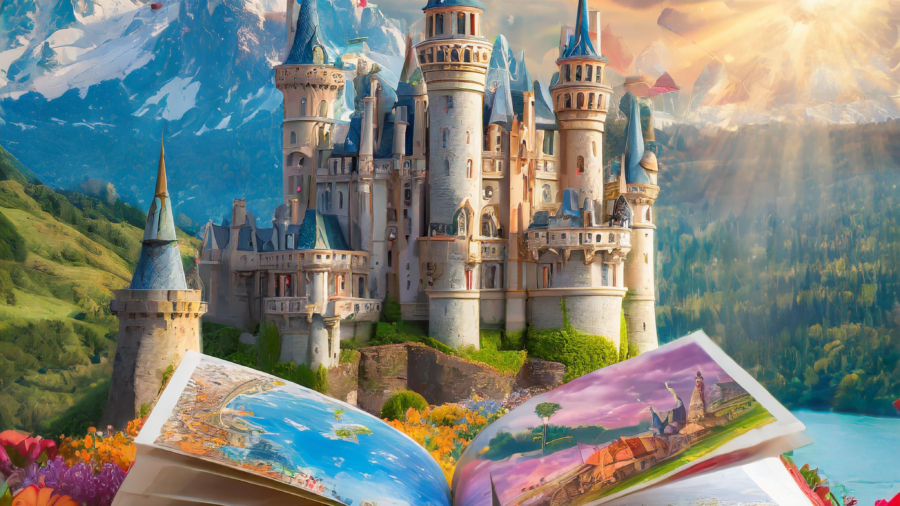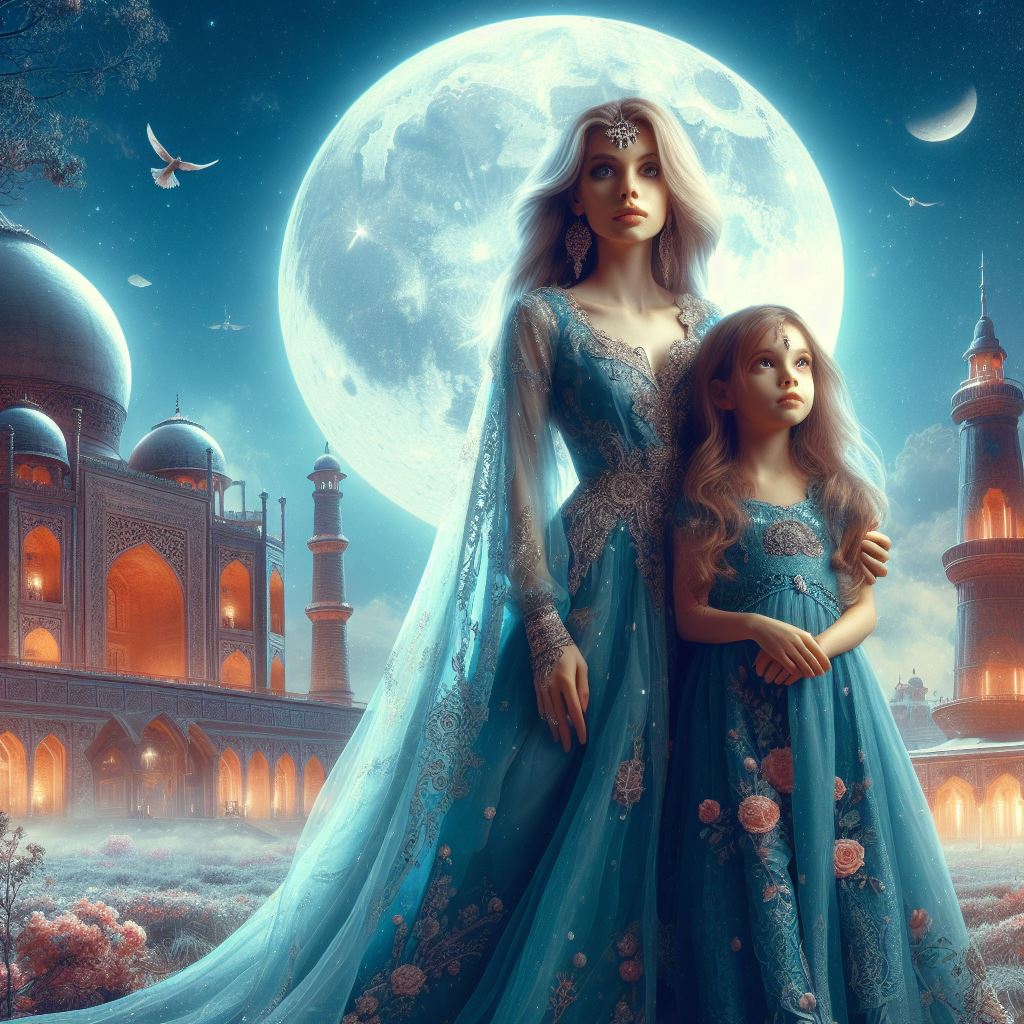
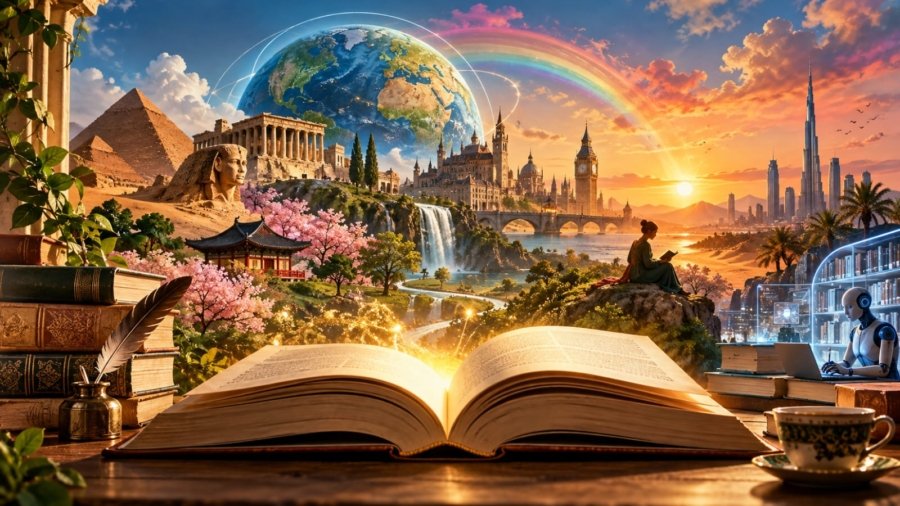
Original editorial illustration representing the novel as a global literary form through a desert, rainbow, open book, human imagination and the AI era.

Novel Definition: A Critical, Literary and Theoretical Study in 2026

Ask a dictionary what a novel is, and it will tell you: a long fictional narrative in prose. Ask a literary scholar, and the answer becomes far more interesting. Pushkin wrote a novel in verse. Art Spiegelman told a true family history in drawn panels. Truman Capote called his account of a real murder a “nonfiction novel.” Each of these works breaks at least one part of the dictionary formula, yet readers and critics still call them novels.

This is why a serious Novel Definition cannot stop at the dictionary. The novel has changed across centuries and languages, from Greek prose romances and Murasaki Shikibu’s The Tale of Genji to Cervantes, Austen, Tolstoy, Achebe and García Márquez. In 2026 it is also read on screens, heard as audiobooks, serialised on web platforms and, increasingly, drafted with the help of artificial intelligence.

This article moves from the word’s basic meaning to its literary and theoretical definitions, through history, technique, and global traditions, to the digital and AI debates of 2026. It ends with a clearly labelled contemporary working definition, offered as a synthesis rather than an official verdict.

Novel Definition: The Basic Meaning

At its simplest, a novel is a sustained narrative, usually in prose, that tells an invented or imaginatively reshaped story through characters, events and settings developed at length.

The English word comes from the Italian novella, a short tale of something new, and ultimately from Latin novus, “new.” Most European languages use a word descended from romance instead: French roman, German Roman, Russian roman. English kept both words, and eighteenth-century critics such as Clara Reeve, in The Progress of Romance (1785), used them to separate realistic stories of ordinary life (novels) from tales of the marvellous (romances).

It helps to separate three levels of definition:

  • Lexical definition. Dictionaries record common usage: a long, invented prose narrative about human experience. This is descriptive and does not try to settle borderline cases.
  • Literary definition. Scholars describe the novel as an artistic form with typical techniques: narrator, point of view, plot, character and structure. E. M. Forster, in Aspects of the Novel (1927), borrowed the French critic Abel Chevalley’s formula, “a fiction in prose of a certain extent,” and then joked that anything over 50,000 words would do. The joke was the point: length and prose are convenient markers, not the essence.
  • Theoretical definition. Theorists ask what the novel does in relation to history, society, language and consciousness. Their answers are arguments, not descriptions.

The phrase “a long prose fictional narrative” is therefore useful as a starting point but insufficient as a full account. A dictionary tells us how the word is used; a literary definition tells us how the form works; a theoretical definition tells us why the form exists.

The Traditional Definition: A Critical Analysis

Each term in the traditional formula deserves scrutiny.

Long. Novels range from compact works such as Albert Camus’s The Stranger to the multi-volume sweep of Proust’s In Search of Lost Time. Publishing conventions draw rough lines: the Nebula Awards, for example, treat works of 17,500 to 40,000 words as novellas and longer works as novels. Such thresholds are practical, not theoretical. Length matters because it allows development over time, not because a word count defines the form.

Prose. Prose became dominant because it is flexible enough to hold dialogue, description and thought. Yet verse novels exist and are widely accepted: Pushkin’s Eugene Onegin (1833), Vikram Seth’s The Golden Gate (1986) and Bernardine Evaristo’s The Emperor’s Babe (2001). Prose is typical, not essential.

Fictional. Fictionality means the events are invented or reshaped by imagination. Autofiction, a term coined by Serge Doubrovsky in 1977, deliberately blurs memoir and fiction, as in Karl Ove Knausgaard’s My Struggle. Historical novels place invented lives among real events. The nonfiction novel applies fictional techniques to fact. These works show that imaginative shaping matters more than literal invention.

Narrative. Narrative is the strongest candidate for an essential feature. Even fragmentary works such as Julio Cortázar’s Hopscotch (1963), which invites readers to follow alternative chapter orders, still ask the reader to assemble a story.

The traditional definition works well for the typical modern novel. It struggles at the edges, and the edges are exactly where much of contemporary fiction now lives.

Historical Development of the Novel

The novel has no single, agreed point of origin. Historians usually distinguish between narrative precursors, early long prose fiction found in many cultures, and the modern novel as a recognisable literary form, which most accounts associate with early modern Europe.

Ancient and classical prose fiction. Greek prose romances such as Longus’s Daphnis and Chloe and Heliodorus’s Aethiopica, and Latin works such as Apuleius’s The Golden Ass, tell extended stories of love, adventure and transformation. Classicists often call them “ancient novels,” though whether they belong to the same form as later novels is debated.

Medieval narrative. In early eleventh-century Japan, Murasaki Shikibu’s The Tale of Genji offered a long prose narrative of court life with striking psychological subtlety. Medieval Europe produced prose Arthurian romances, while Chinese vernacular narratives such as Journey to the West and later Dream of the Red Chamber developed into what English scholarship routinely calls the classic Chinese novel.

Early modern fiction. The Spanish picaresque Lazarillo de Tormes (1554) gave a low-born narrator his own voice. Cervantes’s Don Quixote (1605, 1615) set a reader of chivalric romances against a stubborn everyday world, and many critics treat it as the first modern novel.

The eighteenth century. In England, Daniel Defoe’s Robinson Crusoe (1719), Samuel Richardson’s Pamela (1740) and Henry Fielding’s Tom Jones (1749) helped create a market for long fiction about ordinary individuals. Rising literacy, cheaper printing, circulating libraries and a growing middle class all contributed. Laurence Sterne’s Tristram Shandy (1759–1767) parodied the new form almost immediately.

Nineteenth-century realism. Austen, Balzac, Dickens, Flaubert, George Eliot, Tolstoy and Dostoevsky made the novel the dominant literary form of the age, often through serial publication in magazines.

Modernism, postmodernism and after. Joyce, Woolf, Proust and Kafka turned the novel toward consciousness and fragmented time. Postmodern writers such as Nabokov and Calvino made fiction openly aware of its own artifice. Postcolonial writers, including Chinua Achebe and Salman Rushdie, reshaped the form from outside its European centre.

Scholars disagree sharply about how to tell this story. Ian Watt’s The Rise of the Novel (1957) argued that the modern novel emerged in eighteenth-century England alongside individualism and the middle-class reading public. Michael McKeon’s The Origins of the English Novel, 1600–1740 (1987) saw it crystallising from a crisis in older ideas of truth and virtue. Margaret Anne Doody’s The True Story of the Novel (1996) argued for an unbroken tradition of prose fiction reaching back to antiquity. Each explains something real; none settles the question alone.

The Novel as a Global Literary Form

The modern novel did not simply spread outward from Europe. Where it travelled through print, colonial contact and translation, local writers adapted it to their own histories, languages, religious contexts and narrative inheritances. Franco Moretti, in “Conjectures on World Literature” (2000), observed that new novel traditions often arise as a compromise between a foreign form and local material and voice.

The pattern looks different in each place. In Japan, Natsume Sōseki’s Kokoro (1914) used the novel to examine the strain between Meiji modernisation and older loyalties. In Egypt, Naguib Mahfouz’s Cairo Trilogy (1956–1957) traced a family through national upheaval; he received the Nobel Prize in 1988. In Bengal, Rabindranath Tagore’s Gora (1910) explored religion, identity and nationalism. In Nigeria, Achebe’s Things Fall Apart (1958) narrated colonial disruption from within Igbo society, answering European novels that had represented Africa from outside. In Latin America, Machado de Assis’s The Posthumous Memoirs of Brás Cubas (1881) anticipated modernist irony, and the 1960s “Boom” of García Márquez, Cortázar and Vargas Llosa brought magical realism to world attention. In the Caribbean, Jean Rhys’s Wide Sargasso Sea (1966) rewrote Jane Eyre from the perspective of its Creole “madwoman.” In Korea, Han Kang’s The Vegetarian reached global readers in translation, and she received the Nobel Prize in 2024.

South Asian traditions show the same creative adaptation. The Urdu novel grew from the long dastan romance tradition and the reformist climate after 1857. Deputy Nazir Ahmad’s Mirat-ul-Uroos (1869) is widely regarded as the first Urdu novel, and Mirza Hadi Ruswa’s Umrao Jan Ada (1899) is often praised as its first artistically mature example. In the twentieth century, Qurratulain Hyder’s Aag Ka Darya (1959) spanned more than two thousand years of South Asian history, while Abdullah Hussain’s Udas Naslein (1963) and Khadija Mastoor’s Aangan (1962) explored Partition and its human cost. Intizar Husain’s Basti (1979) blended memory, myth and displacement. These works absorbed European techniques while transforming them through Persianate culture, oral storytelling and South Asian history.

The lesson for any definition is clear: a model built only on eighteenth-century England will misdescribe much of the world’s fiction.

Major Theorists of the Novel

Each major theorist answers the question “what is a novel?” from a different angle.

Aristotle. The Poetics (4th century BCE) predates the novel, but its account of literature as mimesis, the imitation of human action, and of plot as the organising principle of narrative, shaped every later theory of storytelling.

Georg Lukács. In The Theory of the Novel (1920), Lukács contrasted the epic, which expressed a world experienced as whole, with the novel, the form of a modern world in which meaning must be searched for. His insight ties the novel to modern alienation; critics note that it fits popular and non-Western fiction less well.

Mikhail Bakhtin. In essays collected in English as The Dialogic Imagination (1981), Bakhtin defined the novel by heteroglossia, the many social languages it brings into dialogue. In “Epic and Novel”, he argued that the novel is the one genre still developing, constantly absorbing and parodying others. This explains the form’s hybridity unusually well.

Erich Auerbach. Mimesis (1946) traced how Western literature came to treat ordinary people and everyday life seriously. The realist novel is the culmination of that history.

Ian Watt. The Rise of the Novel (1957) defined the early English novel by formal realism: particular individuals, specific times and places, plain referential language. Later critics, including Doody, faulted its focus on England and its neglect of earlier and women’s fiction.

René Wellek and Austin Warren. Theory of Literature (1949) distinguished the realistic novel from the poetic or marvellous romance, a distinction still common in textbooks.

Northrop Frye. Anatomy of Criticism (1957) divided prose fiction into four forms: novel, romance, confession and anatomy. Most actual books mix them, which helps explain why Moby-Dick or Gulliver’s Travels feel only partly like “novels.”

Gérard Genette. Narrative Discourse (1972) supplied the standard tools of narrative analysis: order, duration, frequency, mood (including focalisation) and voice.

Roland Barthes. “The Death of the Author” (1967) shifted meaning from authorial intention to text and reader, an argument now revisited in debates about AI.

Edward Said. Culture and Imperialism (1993) read the European novel alongside empire, most famously in his analysis of Austen’s Mansfield Park, whose English estate depends on a Caribbean plantation.

Terry Eagleton. The English Novel: An Introduction (2005) stressed that the novel resists definition because it borrows freely from every other genre.

Franco Moretti. Through distant reading and the two-volume collection The Novel (2006), Moretti studied the form as a global system rather than a canon of masterpieces.

Taken together, these theories suggest that a strong definition must address narrative arrangement, historical situation, linguistic plurality, the representation of reality and global context, while allowing for constant overlap with other forms.

Table 6: Major Theoretical Approaches to the Novel

Approach Key thinker and work Central idea Main limitation
Mimetic Aristotle, Poetics Literature imitates action; plot organises it Predates the novel
Historical-philosophical Lukács, The Theory of the Novel (1920) The novel expresses a fractured modern world Fits popular and non-Western fiction poorly
Dialogic Bakhtin, The Dialogic Imagination Many social voices; an unfinished genre Less attention to plot and structure
Realist Auerbach, Mimesis (1946); Watt, The Rise of the Novel (1957) Serious representation of everyday individuals Anglocentric; sidelines fantasy and romance
Archetypal Frye, Anatomy of Criticism (1957) Four forms of prose fiction mixed in practice Classification can feel rigid
Narratological Genette, Narrative Discourse (1972) Precise tools for how stories are told Describes technique, not purpose
Post-structuralist Barthes, “The Death of the Author” (1967) Meaning arises from text and reader Downplays historical authorship
Postcolonial Said, Culture and Imperialism (1993) Novels are entangled with empire Can subordinate form to politics
World-systems Moretti, “Conjectures on World Literature” (2000) Foreign form meets local material Distant from close reading

Is the Novel a Genre, a Form or a Mode?

A genre is a kind of literature defined by shared conventions; a form is defined by structure; a mode is a way of seeing that can appear across forms; a literary category is a looser grouping. The novel fits all four uneasily.

Frye treated it as one form of prose fiction among several. Bakhtin treated it almost as an anti-genre that swallows others. Most current scholarship treats “the novel” as a broad literary form that contains many genres, including romance, crime, science fiction and fantasy, with unstable edges. It is highly recognisable and extraordinarily flexible at the same time, and that combination is part of what makes it distinctive.

Major Characteristics of a Novel

The characteristics of a novel are typical, not compulsory. Some experimental novels deliberately remove plot, conventional characters, or continuity.

Table 2: Major Characteristics of a Novel

Characteristic What it does Example
Sustained narrative Arranges events across time Tolstoy, War and Peace
Prose Flexible medium for dialogue, description and thought Eliot, Middlemarch
Fictionality Invents or imaginatively reshapes events Shelley, Frankenstein
Scope and length Allows many characters, subplots and change Dickens, Bleak House
Characterisation Builds people with motives and inner lives Austen, Emma
Plot Organises events by cause and conflict Collins, The Moonstone
Setting Places action in social and physical space Hardy, Tess of the d’Urbervilles
Point of view and voice Filters what readers know and trust Ishiguro, The Remains of the Day
Theme and symbolism Raises questions beyond the literal story Melville, Moby-Dick
Psychological depth Represents consciousness from inside Woolf, Mrs Dalloway
Social context Connects individual lives to society Achebe, Things Fall Apart
Language and style Makes the way of telling part of the meaning Joyce, Ulysses

Structure of the Novel

The classic novel structure moves through exposition, conflict, development, climax and resolution, often illustrated with Gustav Freytag’s pyramid (1863), which was originally designed for drama. Novels add layers drama cannot easily hold: subplots, digressions, parallel narratives and episodes spanning generations.

Modern novels frequently break this arc. Open endings leave conflicts unresolved. Circular structures return to their beginning, as Joyce’s Finnegans Wake does when its last sentence loops into its first. Multiple timelines run side by side in David Mitchell’s Cloud Atlas (2004). Kurt Vonnegut’s Slaughterhouse-Five (1969) follows a hero “unstuck in time.” These experiments do not abandon structure; they make arrangement part of the meaning.

Characterisation

Forster distinguished flat characters, built around a single idea, from round characters, capable of surprising the reader convincingly. Critics also separate dynamic characters, who change, from static ones, and protagonists and antagonists from supporting figures.

Novelists build character through dialogue, action and description, but the form’s most distinctive achievement is access to inner life. Interior monologue presents thought directly. Stream of consciousness, a phrase borrowed from the psychologist William James, renders the unedited flow of perception, as in Woolf’s Mrs Dalloway (1925). Free indirect discourse, perfected by Austen and Flaubert, blends narrator and character without quotation marks. Dorrit Cohn’s Transparent Minds (1978) remains the classic study of these techniques. This ability to represent minds from inside is one reason the novel represents human experience so powerfully.

Narrative Techniques

Narrative technique decides what readers learn and how far they trust it. First-person narration offers intimacy but limits knowledge. Second-person narration, rarer, implicates the reader directly, as in Calvino’s If on a Winter’s Night a Traveller (1979) or Mohsin Hamid’s How to Get Filthy Rich in Rising Asia (2013). Third-person omniscient narration moves across minds, as in Eliot’s Middlemarch; limited narration stays close to one perspective.

Wayne C. Booth’s The Rhetoric of Fiction (1961) established the term unreliable narrator, exemplified by the butler of Kazuo Ishiguro’s The Remains of the Day. Frame narratives nest stories within stories, as in Frankenstein and Wuthering Heights. Epistolary narration builds the story from letters or documents. Metafiction, studied by Patricia Waugh in Metafiction (1984), draws attention to its own fictionality. These are not neutral containers: each technique shapes what a novel can mean.

The Novel and Reality

Novels do not simply copy reality; they interpret, reconstruct, question and reimagine it. Realism builds a recognisable social world in close detail, but it is one model among several. Dostoevsky pursues psychological reality; Tolstoy’s War and Peace recreates historical reality through invented lives; Proust and Woolf render subjective reality; Kafka and García Márquez create imagined realities that illuminate our own.

Dorrit Cohn’s The Distinction of Fiction (1999) argued that fiction’s freedom to enter other minds is exactly what separates it from history and biography. A novel’s events may not be true, yet readers often find in novels truths about memory, history and feeling that other forms cannot reach.

The Novel and Human Experience

The novel’s length and interiority make it unusually suited to experience lived over time. Proust builds a self from involuntary memory. Tolstoy’s Anna Karenina traces desire against social law. The Death of Ivan Ilyich confronts mortality. Kafka and Camus portray alienation. Toni Morrison’s Beloved (1987) makes historical trauma intimate. Themes of identity, love, loneliness, belonging, family and hope are not unique to the novel, but its ability to follow one consciousness or many across years gives them unusual depth.

Philosophical Dimensions

Many novels function as philosophical inquiry carried out through story. Jean-Paul Sartre’s Nausea (1938) and Camus’s The Stranger (1942) dramatise freedom and absurdity. Marxist critics from Lukács to Fredric Jameson’s The Political Unconscious (1981) read novels as expressions of social history. Peter Brooks’s Reading for the Plot (1984) uses psychoanalysis to explain why plots move toward endings. Structuralism and post-structuralism analyse narrative as a system of signs. Feminist criticism, from Woolf’s A Room of One’s Own (1929) to Gilbert and Gubar’s The Madwoman in the Attic (1979), examines who writes and how women are represented. Wolfgang Iser’s reader-response theory shows how gaps in a text invite readers to complete it.

These frameworks are tools, not replacements for reading. A novel’s ideas live in characters, situations and language, and the literary text remains central.

Social, Cultural and Political Dimensions

The novel has long been tied to social change. Dickens’s Hard Times and Elizabeth Gaskell’s North and South responded to industrial England. Charlotte Brontë’s Jane Eyre challenged limits on women’s independence. Premchand’s Hindi novel Godaan (1936) followed a peasant crushed by debt. Mohsin Hamid’s Exit West (2017) explored migration and diaspora through magical doors. Novels also preserve cultural memory: Partition fiction across South Asian languages keeps alive experiences that official histories compress.

Politically, Benedict Anderson’s Imagined Communities (1983) argued that novels and newspapers helped readers imagine themselves as members of a nation. George Orwell’s Nineteen Eighty-Four (1949) examined state power and propaganda. Ngũgĩ wa Thiong’o drafted Devil on the Cross while detained without trial in 1978. Boris Pasternak’s Doctor Zhivago was first published in Italy in 1957 after being refused in the Soviet Union. Theories of political reading are themselves debated: Jameson’s 1986 claim that “third-world” texts should be read as national allegories was sharply criticised by Aijaz Ahmad in 1987.

Representation has limits. Every novel selects and speaks from a particular position, which is why postcolonial and feminist critics read for what novels leave out as well as what they preserve.

Language and Style

In a novel, language is part of the meaning, not a container for it. Flaubert’s search for the exact word made style a discipline. Mark Twain’s Adventures of Huckleberry Finn (1884) made vernacular dialect literary. Achebe reshaped English with Igbo proverbs and rhythms, while Ngũgĩ, in Decolonising the Mind (1986), explained his decision to write fiction in Gikuyu. Austen’s irony allows a single sentence to report a character’s view and quietly judge it. Vocabulary, syntax, rhythm, register, metaphor and narrative voice all shape whether a reader trusts, loves or resists a novel.

Types of Novels

The types of novels below overlap constantly. Frankenstein is Gothic, science fiction and philosophical at once; Jane Eyre is a Bildungsroman, a romance and a Gothic novel. Genre labels describe tendencies, not fixed boxes.

Table 3: Types of Novels

Type Defining tendency Representative example
Literary novel Style, character and theme over formula Toni Morrison, Beloved (1987)
Historical novel Invented lives in a reconstructed past Walter Scott, Waverley (1814)
Social novel Exposes social conditions Elizabeth Gaskell, North and South (1855)
Psychological novel Centres on inner life and motive Dostoevsky, Crime and Punishment (1866)
Romance Love and its obstacles Jane Austen, Pride and Prejudice (1813)
Mystery and detective A puzzle or crime and its solution Wilkie Collins, The Moonstone (1868)
Crime and thriller Suspense, danger and moral ambiguity Patricia Highsmith, The Talented Mr Ripley (1955)
Gothic and horror Fear, the uncanny, the haunting past Bram Stoker, Dracula (1897)
Science fiction Speculation grounded in science Mary Shelley, Frankenstein (1818)
Fantasy Secondary worlds and the marvellous J. R. R. Tolkien, The Lord of the Rings (1954–1955)
Dystopian Imagined oppressive societies Aldous Huxley, Brave New World (1932)
Bildungsroman Growth to maturity Charlotte Brontë, Jane Eyre (1847)
Satirical Exposes folly through irony Jonathan Swift, Gulliver’s Travels (1726)
Political Power, ideology and the state George Orwell, Nineteen Eighty-Four (1949)
Philosophical Ideas explored through story Albert Camus, The Stranger (1942)
Epistolary Told through letters or documents Samuel Richardson, Pamela (1740)
Experimental Breaks conventional form Laurence Sterne, Tristram Shandy (1759–1767)
Metafiction Reflects on its own fictionality Italo Calvino, If on a Winter’s Night a Traveller (1979)
Autofiction Blends the author’s life with fiction Karl Ove Knausgaard, My Struggle (2009–2011)

The Novel and Related Literary Forms

Comparing the novel with neighbouring forms clarifies its distinctiveness. A short story usually centres on one incident or effect; a novella follows a single main line of action; the novel sustains multiple characters, subplots and development. Bakhtin contrasted the closed, heroic past of the epic with the novel’s open, unfinished present. Biography and memoir are judged by factual accuracy; the novel by imaginative coherence. Drama is written for performance; the novel uses a narrator who can describe thought directly. Graphic novels and digital fiction raise the question of whether the novel is defined by medium or by narrative scope.

Table 4: Novel vs Short Story vs Novella

Feature Short story Novella Novel
Typical length Under about 7,500 words About 17,500–40,000 words Over about 40,000 words
Focus One incident or effect One main line of action Multiple lines, subplots
Characters Few, briefly sketched Small cast, some depth Large cast, full development
Time span Moments to days Limited period Months to generations
Example James Joyce, “The Dead” Franz Kafka, The Metamorphosis Leo Tolstoy, Anna Karenina

Word ranges follow common publishing conventions, such as those of the Nebula Awards; they are guides, not rules.

Table 5: Novel and Related Literary Forms

Form Key difference from the novel Example
Epic Verse; heroic, closed past (Bakhtin) Homer, The Odyssey
Romance Idealised and marvellous rather than realistic Malory, Le Morte d’Arthur
Biography and memoir Judged by factual accuracy Augustine, Confessions
Drama Written for performance, no narrator Shakespeare, Hamlet
Graphic novel Sequential images and text Art Spiegelman, Maus
Verse novel Novelistic scope in verse Pushkin, Eugene Onegin
Nonfiction novel Fictional technique applied to fact Truman Capote, In Cold Blood
Digital fiction Screen-based, sometimes interactive or branching Michael Joyce, afternoon, a story (1987)

The Modern and Contemporary Novel

Twentieth- and twenty-first-century novelists have repeatedly tested inherited conventions. Modernists replaced external plot with consciousness. Postmodernists such as Nabokov in Pale Fire (1962) used metafiction, pastiche and intertextuality. Magical realism, from García Márquez’s One Hundred Years of Solitude (1967) to Rushdie’s Midnight’s Children (1981), gave postcolonial writers a way to represent histories realism could not hold. Autofiction became one of the defining trends of the 2010s, from Knausgaard to Rachel Cusk’s Outline trilogy. Migration and diaspora fiction, from Hamid to Chimamanda Ngozi Adichie’s Americanah (2013), made movement between cultures a central subject. Each experiment exposed an assumption and widened what readers accept as a novel.

Table 7: Traditional Novel vs Contemporary/Experimental Novel

Aspect Traditional novel Contemporary or experimental novel
Plot Linear, cause and effect Fragmented, circular or multi-timeline
Narrator Reliable, often omniscient Unreliable, multiple or second-person
Reality Realist representation Magical, self-reflexive or hybrid
Fiction and fact Clearly separated Blurred in autofiction and documentary fiction
Ending Resolution Open or ambiguous
Example Austen, Pride and Prejudice Mitchell, Cloud Atlas

The Novel in the Digital Age

Digital technology has transformed how novels are published, distributed and read. E-books and self-publishing platforms let authors reach readers without traditional publishers. Serial platforms such as Wattpad revived the nineteenth-century instalment, now with reader comments arriving chapter by chapter. Online communities, from Goodreads to BookTok, influence which books succeed.

Audiobooks have become a major way of experiencing fiction. According to the Audio Publishers Association’s survey released in 2026, US audiobook sales reached $2.43 billion in 2025, up 9 per cent, and general fiction was the largest revenue category at 27 per cent. The same research found that 58 per cent of American adults have listened to an audiobook.

The critical question is whether these are changes of medium or of form. An audiobook of Middlemarch is still Middlemarch. Interactive fiction and serial fiction shaped by live reader feedback, however, do challenge the idea of the novel as a single fixed text by a single author.

The Novel in the AI Era

Artificial intelligence raises the most debated questions about the novel in 2026. It helps to separate what is known from what is argued.

Established facts. In its January 2025 report on copyrightability, the US Copyright Office concluded that copyright requires human authorship, that prompts alone do not make a user the author of AI output, and that human selection, arrangement or modification of AI material can be protected. In January 2024, Rie Kudan received Japan’s Akutagawa Prize for Tokyo-to Dojo-to (Sympathy Tower Tokyo), a novel about AI, and said that around five per cent of its text came directly from generative AI; a selection committee member said the committee did not consider this a problem. In March 2026, Hachette cancelled Mia Ballard’s horror novel Shy Girl after readers, an AI-detection firm and the New York Times raised concerns about AI-generated text; the author denied using AI herself and said a freelance editor had. Reports described it as the first such cancellation by a major publisher. Meanwhile, AI-narrated titles accounted for only about 0.03 per cent of 2025 US audiobook revenue.

Scholarly debates. Can a system trained on existing texts produce genuine originality, or only recombination? Barthes’s “death of the author” might seem to make authorship irrelevant, but theories of the novel from Lukács to Cohn tie the form to human consciousness and lived experience.

Industry positions and emerging practice. Publishers increasingly ask authors to disclose AI use, and AI-assisted translation and editing raise questions about editorial responsibility and the translator’s craft.

Unresolved questions. Whether a wholly machine-generated long narrative “counts” as a novel is not settled in law, scholarship or reader practice. The evidence does not show that AI has replaced human novelists. It does show that authorship, once assumed, is now part of what a definition must address.

Table 8: Print Era vs Digital Era vs AI Era

Aspect Print era Digital era AI era (emerging)
Production Author, editor, printer Author with digital tools; self-publishing AI-assisted drafting, editing and translation
Distribution Bookshops, libraries, magazines E-books, audiobooks, web serials Same channels, plus AI-generated titles
Reader role Private reading Online reviews, communities, comments Expectations of disclosure and authenticity
Authorship Assumed human Human, sometimes collaborative Human authorship required for US copyright; AI role debated
Key question Is it good? Who finds it? Who wrote it?

Novel Definition in 2026

Does the traditional definition still work? For most novels, yes. But five pressures now stretch it: hybrid forms such as autofiction and verse novels; graphic storytelling; digital, serial and interactive fiction; global literary exchange; and AI-assisted production.

At the same time, certain elements remain remarkably stable across nearly every work readers call a novel: sustained narrative, imaginative shaping, the representation of characters’ experience over time, and enough scope to build a world. A 2026 Novel Definition should therefore expand at the edges while keeping its centre.

Table 1: Traditional Definition vs Contemporary Definition

Aspect Traditional definition Contemporary understanding
Form Prose Prose dominant; verse, graphic and hybrid forms debated
Length Long Flexible; set by convention, not theory
Fictionality Invented story Imaginative shaping; autofiction blurs the line
Structure Continuous plot May be fragmented, nonlinear or interactive
Medium Printed book Print, e-book, audio and digital serial
Authorship Single human author Human authorship still central; AI assistance debated
Geography European model as standard Plural global traditions

Critical Debates

Can the novel have one universal definition? Dictionaries say yes at the level of typical features; historicists tie the novel to particular societies; Bakhtin and Eagleton see openness as its nature. Most scholarship now treats it as a family of works.

Is length or prose essential? Some extent is needed for development, but no threshold exists, and verse novels show prose is typical rather than required.

Must a novel be fictional or have a conventional plot? Autofiction and nonfiction novels blur fictionality but still use fiction’s techniques. Fragmentary novels reject conventional plot yet still invite readers to build a story.

Can graphic works be novels? Supporters point to the sustained narrative of works like Maus; sceptics see sequential art as a distinct medium.

How do digital and AI narratives affect the definition? Linear digital serials clearly qualify; branching interactive works are contested. AI-generated narratives may have every textual feature of a novel, but whether a text without a human perspective is a novel remains unresolved.

Contemporary Working Definition

The following is this article’s synthesis, built from the evidence above. It is a contemporary working definition, not a universally accepted academic definition.

A novel is a sustained narrative work, usually in prose and usually fictional or imaginatively reshaped, whose extended scope allows it to develop characters or experiential perspectives across time and space within a represented world. Historically flexible and generically open, it absorbs and transforms other forms and languages, takes shape differently across literary cultures, and now circulates in print, audio and digital media. Its centre lies in the imaginative representation of human experience through artistic structure and language; its edges, where verse, image, fact, interactivity and machine assistance enter, remain matters of convention and critical debate.

Each element follows from the discussion: sustained narrative from the boundary cases; “usually” prose and fiction from verse novels and autofiction; character, time and consciousness from Forster, Watt, Genette and Cohn; generic openness from Bakhtin, Frye and Eagleton; cultural variation from Moretti, Said and the global traditions; and the debated edges from digital and AI developments.

Conclusion: What Is a Novel in 2026?

The traditional answer, a long fictional narrative in prose, remains a sound starting point. History complicates it: long prose fiction appears in ancient Greece, Heian Japan and Ming China, while the modern novel took shape in early modern Europe and was then transformed in Arabic, Bengali, Urdu, African, Latin American and Caribbean literatures.

Theory complicates it further. Lukács ties the novel to modern alienation, Bakhtin to the dialogue of voices, Watt to individual experience, Frye to mixed prose forms, and Moretti and Said to global systems and empire. Each insight is partial; together they show why the form resists a single formula.

The novel’s characteristic achievements are clear: sustained narrative, deep characterisation, access to consciousness and the representation of human experience over time. In 2026, digital publishing, audiobooks and AI tools are changing how novels are produced and encountered, and human authorship has become a question rather than an assumption.

The most defensible Novel Definition today is therefore layered: firm at the centre, where narrative imagination represents human experience at length, and open at the edges, where new forms continue to test what the novel can become. That openness is not a weakness of the definition. As Bakhtin suggested, it is a defining characteristic of the novel itself.

Frequently Asked Questions

What is a novel?

A novel is a sustained narrative, usually in prose and usually fictional, that develops characters and events at length. This basic Novel Definition is a starting point; scholars add that the form is flexible and varies across history and cultures.

What is the literary definition of a novel?

Literary scholars describe the novel as an extended narrative form that represents human experience through character, plot, setting, point of view and narrative voice, often with deep access to characters’ inner lives.

Why is a novel usually written in prose?

Prose is flexible enough to combine dialogue, description, action and thought in one continuous medium, which suits the novel’s interest in everyday life and inner experience. It became dominant historically, but it is not strictly required.

How long does a novel have to be?

There is no theoretical minimum. Publishing conventions give rough guides; the Nebula Awards, for example, treat works over 40,000 words as novels.

What are the main characteristics of a novel?

Sustained narrative, prose, fictionality, scope, characterisation, plot, setting, point of view, narrative voice, theme and language. Not every novel contains every feature.

What are the major types of novels?

Literary, historical, social, psychological, romance, mystery, crime, Gothic, science fiction, fantasy, dystopian, Bildungsroman, satirical, political, philosophical, epistolary, experimental, metafiction and autofiction. Many novels belong to several types at once.

What is the difference between a novel and a novella?

A novella is shorter and usually follows one main line of action with a small cast; a novel has room for subplots, more characters and longer development.

How has the novel developed across world literature?

Long prose fiction appears in ancient Greece, medieval Japan and China, while the modern novel took shape in early modern Europe. Writers in Arabic, Bengali, Urdu, Japanese, African, Latin American and Caribbean literatures then adapted it to their own languages, histories and storytelling traditions.

Can a verse or graphic work be considered a novel?

Verse novels such as Eugene Onegin are widely accepted. Graphic novels are debated: supporters stress their sustained narrative, while sceptics treat sequential art as a separate medium.

How is the definition of the novel changing in the digital and AI era?

E-books, audiobooks and web serials have changed how novels circulate, and AI tools have raised questions about authorship. US copyright law still requires human authorship, and whether wholly machine-generated narratives count as novels remains unresolved.

Sources and Further Reading

Theory and criticism

  • Aristotle. Poetics. 4th century BCE.
  • Forster, E. M. Aspects of the Novel. Edward Arnold, 1927.
  • Lukács, Georg. The Theory of the Novel. 1920; trans. Anna Bostock, MIT Press, 1971.
  • Bakhtin, M. M. The Dialogic Imagination. Ed. Michael Holquist. University of Texas Press, 1981.
  • Auerbach, Erich. Mimesis. 1946; trans. Willard R. Trask, Princeton University Press, 1953.
  • Wellek, René, and Austin Warren. Theory of Literature. Harcourt, Brace, 1949.
  • Watt, Ian. The Rise of the Novel. Chatto & Windus, 1957.
  • Frye, Northrop. Anatomy of Criticism. Princeton University Press, 1957.
  • Booth, Wayne C. The Rhetoric of Fiction. University of Chicago Press, 1961.
  • Genette, Gérard. Narrative Discourse. 1972; trans. Jane E. Lewin, Cornell University Press, 1980.
  • Barthes, Roland. “The Death of the Author.” In Image-Music-Text, Fontana, 1977.
  • Cohn, Dorrit. Transparent Minds. Princeton University Press, 1978; The Distinction of Fiction. Johns Hopkins University Press, 1999.
  • Jameson, Fredric. The Political Unconscious. Cornell University Press, 1981.
  • Anderson, Benedict. Imagined Communities. Verso, 1983.
  • Brooks, Peter. Reading for the Plot. Knopf, 1984.
  • Waugh, Patricia. Metafiction. Methuen, 1984.
  • Ngũgĩ wa Thiong’o. Decolonising the Mind. James Currey, 1986.
  • McKeon, Michael. The Origins of the English Novel, 1600–1740. Johns Hopkins University Press, 1987.
  • Said, Edward W. Culture and Imperialism. Knopf, 1993.
  • Doody, Margaret Anne. The True Story of the Novel. Rutgers University Press, 1996.
  • Moretti, Franco. “Conjectures on World Literature.” New Left Review 1, 2000; ed., The Novel, 2 vols., Princeton University Press, 2006.
  • Eagleton, Terry. The English Novel: An Introduction. Blackwell, 2005.
  • Russell, Ralph. The Pursuit of Urdu Literature: A Select History. Zed Books, 1992.

2026 developments

poems about life

Best Poems About Life: Where Words Dance with the Soul

The creative person sees life from more angles and in more ways than the ordinary person. A deep analysis of the beauty and ugliness of life is found in poetry and literature. Life is not as simple as it appears on the surface; it is full of complexities and its colors are very diverse. It is both very compassionate and, in some ways, very cruel. Life and circumstances are inseparable; circumstances have a profound impact on life. Circumstances can be good or bad, but the word “circumstances” generally refers to the negative aspects of life. Remembering past good times is both a source of sadness and a lament for the ugliness of the present.

It is said that the height of poetic expression is that it can say in a few verses what cannot be said even in the longest prose. There are many different conceptions of life. Some conceptions, in the form of traditions, determine our way of life. When a person begins to understand the affairs, mysteries, and realities of life, he expresses his view of life in a certain way. It is also important here that the poet has his life circumstances, in the context in which he expresses his point of view.

Whispers of Wisdom: Unveiling Life's Lessons Through Poems about Life

Poetry is a powerful tool for understanding life. It allows us to see the world from different perspectives and to experience a wide range of emotions. By reading and analyzing poetry, we can learn more about ourselves and the world around us.

The Importance of Context

It is important to remember that no single poem can tell us everything about a poet’s life or work. Each poem is a reflection of a particular moment in time, and it is important to consider the context in which it was written.

The Variety of Human Experience

Poetry offers us a glimpse into the many different ways that people experience life. Some poets see life as a source of joy and beauty, while others see it as a source of pain and suffering. There is no one right way to view life, and poetry can help us to appreciate the diversity of human experience.

Learning from life poems,different Perspectives on Life

By reading and reflecting on poetry, we can learn valuable lessons about life.We can learn about the importance of love, compassion, and understanding. We can also learn about the challenges of life and how to overcome them.

Some people believe that the essence of life is love. They see love as the driving force behind all human actions and emotions.
Others believe that life is about experiencing a wide range of emotions, both positive and negative. They argue that it is through these experiences that we learn and grow as individuals.
Still others believe that life is about finding beauty amid pain and suffering. They see the challenges of life as opportunities for strength and resilience.
Finally, some people believe that life is simply about being happy. They focus on enjoying the present moment and finding joy in the simple things.

Horace certainly offers a perspective on life through his epic poems.

Here are a few lines capturing his “prescription” for life, drawing from themes in the Iliad and Odyssey.

“A man of worth can even outdo a stronger rival if he is resolute.”
“Like leaves on the trees, so is the generation of mankind. The wind scatters the old ones, while the spring brings forth new ones…”
“It is not right to stay here quiet like a coward, but let me go forth and meet the foe!”
“Fools always speak before they think.”
“Always be the best, strive to be the best…”

poetry about life

Ovid’s poetry that offers prescriptions about life:

“Fortune is ever-changing, so must you.”
This line emphasizes the impermanence of life and the need for adaptability.

“Love is a many-formed thing, and comes in many ways.”
“Live each day as if it were your last.”
This line encourages us to seize the day and make the most of our time.

Novalis was a German poet.

Here are a few lines capturing Novalis’ perspective on life:
“We are of nature, and nature is of us; there is no difference.” This reveals his belief in the interconnectedness of everything and the power of imagination to bridge the gap between humans and the world.

“The blue flower is the first thing one meets in the land of longing.” This famous metaphor depicts life as a journey driven by a deep yearning for an ideal reality, ultimately leading to a transformative experience.

Walt Whitman stands as a giant in American literature.

“I celebrate myself, and sing myself,
And what I assume you shall assume,
For every atom belonging to me as good belongs to you.”
These opening lines of “Song of Myself” capture the essence of Whitman’s perspective on life. He celebrates the individual, yet emphasizes the interconnectedness of all people. He believes that every person is unique and valuable and that we share a common humanity. Through celebrating his existence, he invites the reader to celebrate their own and recognize the shared experience of being human.

Maya Angelou was a powerful American poet, memoirist, and civil rights activist.

Here are two excerpts reflecting her perspective on life:

From “Still I Rise”
“You may write me down in history
With your bitter, twisted lies,
You may trod me in the very dirt
But still, like dust, I’ll rise.”

This poem exemplifies her unwavering spirit in the face of oppression.

From “Phenomenal Woman”
“Pretty women wonder where my secret lies.
It lies in the skin I’m in, in the eyes that are mine.
I walk like I’ve got oil wells
Pumping in my living room.”

This poem celebrates the beauty and strength of Black women, defying societal expectations and embracing their power.

John Milton Known for his epic poem

“Paradise Lost,” Milton grappled with themes of faith, free will, and the nature of good and evil.

William Butler Yeats stands as a towering figure in Irish and world literature.

“Turn away from the drawing room with its gilt chairs and high tea.” (The Lake Isle of Innisfree) This line encourages a simpler life, a rejection of materialism and societal expectations, in favor of a connection with nature.

Amanda Gorman is a young American poet.

“For while we may live in different times,
and come from different places,
we hold in common a future laced
with challenges that transcend our race.

Gorman’s poems celebrate the potential for positive change and the importance of using one’s voice to advocate for a better future. Her work inspires hope and encourages individuals to actively contribute to building a more just and equitable world.

The Urdu poet Mirza Ghalib

Believed that life and sorrow are inseparable. He argued that as long as a person is alive, they will experience some degree of sorrow. This is because life is full of challenges and difficulties, which can lead to sadness, pain, and suffering.

Ghalib’s views on life and sorrow are reflected in his poetry. In one of his most famous ghazals, he writes:

“Since sorrow follows joy
As autumn does spring
Man must transcend the joys
Of earth, which sorrows bring.”

In this ghazal, Ghalib compares the cycle of life and sorrow to the cycle of the seasons. Just as spring is followed by autumn, so too is joy followed by sorrow. This is the natural order of things, and it is something that humans cannot escape.

However, Ghalib does not believe that humans should simply give in to sorrow. Instead, he argues that we should strive to transcend the joys and sorrows of this world. This can be done by focusing on spiritual matters and by seeking a higher truth.

Ghalib’s views on life and sorrow are both pessimistic and hopeful. On the one hand, he believes that sorrow is an inevitable part of life. On the other hand, he believes that humans can transcend sorrow by seeking a higher truth.

The Urdu poet Jaun Elia

Believed that life is about learning to lose in our unique way. He argued that the experiences we have in life, both positive and negative, shape who we are and how we see the world.

Elia’s views on life are reflected in his poetry. In one of his most famous ghazals, he writes:

“We have lived the life that could not be lived by us,
We have lost life in our way.”

In this ghazal, Elia explores the idea of living a life that is true to oneself, even if it means making mistakes and experiencing pain. He argues that it is through these experiences that we learn and grow as individuals.

Elia’s views on life are both challenging and comforting. On the one hand, he challenges us to confront the reality of loss and disappointment. On the other hand, he offers us the comfort of knowing that we are not alone in our struggles.

The Urdu poet Nida Fazli

Believed that life is made up of a few dreams and a few hopes. He argued that it is these dreams and hopes that keep us going, even when things are tough.

Fazli’s views on life are reflected in his poetry. In one of his most famous poems, he writes:

“Life is a few dreams,
And a few hopes,
With these,
Man is forced to be content.”

In this poem, Fazli explores the idea that life is not always easy, but it is still worth living. He argues that it is the dreams and hopes that we have that give our lives meaning and purpose.

Fazli’s views on life are both realistic and hopeful. On the one hand, he acknowledges that life can be difficult. On the other hand, he believes that it is still possible to find happiness and fulfillment.

life poems

Like an uncontrollable wild horse, life rushes shaking the poet and evoking a sense of wonder in them, like a silent spectator. Life’s unbridled direction and speed are becoming a web of engagements, where the day and night sequences are getting longer. Life does not allow the individual to sort things out, and the individual is being carried away by the pace of life, contrary to his desires.

The complexities of life entangle the individual in such a way that he feels his identity is being lost moment by moment. Each changing scene is writing new things on the paper of the sense of life. In the struggle of life, the silence of a few moments feels like a jumbling of time and space.

The human being’s lostness has become entangled in the endless chains of division after division, where the poet feels like saying that the deception of life has taken us a little bit of work that our days have passed.

The poet has many questions about the philosophy of life where the meaninglessness of life, the helplessness of man in front of its relentless pace, and the problem of self-realization are more serious.
Many poets have also mentioned a point in life where the presence or absence of happiness and sadness is considered equal. Some call it apathy, while others call it a place of consciousness.
This is such a complex topic that there are no fixed boundaries. In the end, I present my personal opinion:

Isn’t life just one day,
With morning, noon, evening, and then night?

From birth, a human has the urge to learn and explore,
In youth, to desire and to attain,
The next part of life is spent reaping the rewards of one’s actions,
Then, when matters and realities begin to make sense,
The night of life falls.
And when the reality of life comes to light at night,
It turns out that memories, business,
Life’s affairs, desires, aspirations, regrets,
The desire and effort to achieve and attain,
Were all futile topics
In which one’s life was wasted.
(Saima Aslam)

Overall, it is a thought-provoking poetry that explores the meaning of life and the nature of human existence. It’s a reminder that we shouldn’t take our lives for granted and that we should strive to live each day to the fullest.

Conclusion:

Poetry, from introspective verses to social commentary, provides a window into a wide array of human experiences and perspectives on life. Through their words, poets tackle universal themes such as life, love, loss, joy, sorrow, and the search for meaning, allowing us to explore the depths of the human condition. 

What is your opinion about life? My purpose in writing this article is to raise awareness regarding various topics of life that life is living us or we are living life. Poetry transcends language barriers, letting us connect with the emotions and experiences of individuals from diverse backgrounds and historical periods. We find solace and inspiration in the works of these poets, who offer a space to reflect on our own lives, find comfort in shared experiences, and draw inspiration from their unique perspectives.
As we embark on our journeys, poetry serves as a companion, offering insights, reflections, and a deeper understanding of the human experience. It reminds us that we are not alone in navigating the complexities of life and that through the power of language, we can connect and find meaning in the world around us.

Themes in Literature

Themes in Literature: Why Sci-Fi Needs Them More Than Spaceships

Themes in Literature

Welcome, fellow literary explorers! Step into the boundless world of science fiction, where themes in literature transcend mere storytelling to unlock profound insights into humanity’s past, present, and future. Join us as we journey beyond the stars to unravel why themes in literature are not just a backdrop but the essence that makes sci-fi an unparalleled genre of imagination and reflection.

Beyond the Stars: Sci-Fi Themes Exploring Humanity's Future

Embark on a voyage beyond our earthly confines, where science fiction serves as a visionary lens into the infinite possibilities that await humanity. By exploring themes like artificial intelligence, genetic enhancement, and intergalactic travel, sci-fi propels us into realms where imagination knows no bounds.

In these futuristic landscapes crafted by visionary authors, we confront ethical dilemmas surrounding the advancement of technology and its impact on society. Themes of utopia versus dystopia paint contrasting pictures of what tomorrow may hold for us – a cautionary tale or an aspirational vision yet to be realized.

As we traverse these narratives set against the backdrop of distant galaxies and advanced civilizations, we are prompted to ponder our existence and potential destinies in a universe teeming with mysteries waiting to be unveiled.

Decoding the Message: How Themes in Literature Drive Great Sci-Fi Stories

In the vast universe of science fiction literature, themes play a crucial role in shaping great stories. Themes are not just simple ideas; they are the underlying messages that give depth and meaning to narratives. When we delve into sci-fi tales, we uncover layers of significance woven through futuristic worlds and imaginative scenarios.

Themes in Literature drive great sci-fi stories by serving as guiding principles that explore societal issues, human nature, ethics, or technological advancements in thought-provoking ways. They compel readers to reflect on their own beliefs and perspectives while immersing themselves in captivating adventures across galaxies or alternate dimensions.

By decoding these thematic messages, readers can unravel the intricate web of ideas presented by authors. Themes like artificial intelligence questioning humanity’s essence or time travel exploring consequences create intellectual puzzles for audiences to decipher and ponder upon long after finishing a book.

So next time you pick up a sci-fi novel, pay attention not only to the thrilling plot twists but also to the underlying themes driving the narrative forward – you might discover profound insights hidden within the pages waiting to be decoded.

Themes in Literature

HereFrom Robots to Dystopias: Exploring Unique Sci-Fi Themes

Dystopias:

Sci-fi’s playground doesn’t limit itself to sleek spaceships and laser battles. Delving deeper, we find a treasure trove of unique themes that push the boundaries of our imagination and challenge our understanding of ourselves and the world.
Let’s take a closer look at two such fascinating examples

Robots:

Beyond robotic sidekicks and uprising Terminators, sci-fi explores the complex relationship between humans and machines. Themes like artificial intelligence questioning its creators, blurring the lines between human and machine consciousness, and the ethical implications of granting robots sentience spark philosophical debates and force us to re-evaluate what it means to be human.

Not all futures are bright. Dystopian sci-fi plunges us into worlds ravaged by ecological collapse, totalitarian regimes, or technological dependence, painting stark reminders of the potential consequences of our choices. These themes serve as cautionary tales, urging us to consider the ethical and societal implications of our current path and inspiring us to strive for a brighter future.

But the journey doesn’t end there. From confronting alien cultures and exploring alternate realities to facing the consequences of genetic engineering and questioning the nature of time, sci-fi offers a diverse landscape of unique themes waiting to be unraveled. Each theme acts as a portal, inviting us to contemplate the complexities of existence, ponder the possibilities of tomorrow, and ultimately, gain a deeper understanding of ourselves and the universe we inhabit.

More Than Fun: Sci-Fi Themes & Real-World Impact

While spaceships blasting across the cosmos and laser battles might be a thrilling draw, sci-fi’s impact extends far beyond mere entertainment. Beneath the surface of its imaginative scenarios and futuristic settings lie themes that profoundly resonate with our real world, sparking vital conversations and even influencing technological advancements.

Take themes like artificial intelligence (AI). Sci-fi has long explored the potential dangers and ethical dilemmas of advanced AI, from benevolent robots questioning their programming to malevolent machines seeking world domination. These narratives not only entertain but also serve as a mirror reflecting our anxieties and hopes surrounding the rapid development of AI in our present day. As we push the boundaries of artificial intelligence, sci-fi’s explorations of its potential impact act as a cautionary and aspirational force, encouraging us to consider the ethical implications of our creations.

Similarly, dystopian narratives don’t just warn us of impending doom. They serve as cautionary tales, highlighting the potential consequences of societal trends, environmental concerns, or technological dependence unfolding in our world. Whether it’s climate change mirroring dystopian landscapes ravaged by ecological collapse or totalitarian regimes reflecting our anxieties about surveillance and control, sci-fi compels us to critically examine our present and work towards a better future.

The impact doesn’t stop there. Science fiction has demonstrably influenced real-world advancements. Jules Verne’s visionary descriptions of submarines in “Twenty Thousand Leagues Under the Sea” inspired early underwater exploration, while Arthur C. Clarke’s prediction of geostationary communication satellites in “The Fountains of Paradise” paved the way for the development of our own. These are just a few examples of how sci-fi’s exploration of futuristic concepts can fuel innovation and pave the way for real-world advancements.

Ultimately, sci-fi’s unique themes act as a bridge between imagination and reality, prompting us to ponder the possibilities of tomorrow and consider the implications of our present choices. It’s not just escapism; it’s a powerful tool for reflection, discussion, and even shaping the future we create.

Themes in Literature

From Reader to Analyst: Unlocking Sci-Fi's Meaningful Layers

Step aside from the awe-inspiring visuals and heart-pounding action for a moment, fellow sci-fi enthusiast. Beneath the dazzling surface of futuristic technology and interstellar adventures lies a hidden treasure trove – themes waiting to be unearthed and analyzed. By transitioning from passive reader to active analyst, you unlock a whole new dimension of enjoyment and understanding.


Imagine yourself as a cosmic detective, tasked with unraveling the intricate web of ideas woven into the narrative tapestry. Start by identifying the recurring themes – are they exploring the ethical boundaries of artificial intelligence, grappling with the complexities of time travel, or questioning the definition of humanity in a technologically advanced future?
Once you’ve identified the suspects, delve deeper. How are these themes portrayed through plot points, character interactions, and even seemingly insignificant details? Consider the author’s use of symbolism, metaphors, and foreshadowing – each could be a clue pointing towards a deeper meaning.


Remember, sci-fi themes are rarely black and white. They invite debate, challenge your assumptions, and force you to see the world through a different lens. Don’t shy away from questioning the author’s message, exploring multiple interpretations, and even drawing parallels to real-world issues.


This analytical journey isn’t just about deciphering hidden messages; it’s about enriching your perspective. By actively engaging with the themes, you’ll see the story not just as an entertaining escape, but as a thought-provoking catalyst for introspection. You’ll find yourself questioning your own beliefs, values, and understanding of the world around you.


So, the next time you embark on a sci-fi adventure, remember – you’re not just a passenger on a spaceship; you’re a detective, an analyst, an explorer of the human experience disguised as a thrilling journey through the cosmos. By unlocking the thematic layers, you’ll discover a whole new universe of meaning within the pages, one that resonates with your reality and leaves you pondering long after the final page is turned.

Predicting the Future: Today's Sci-Fi Themes, Tomorrow's Reality

Gazing through the lens of sci-fi themes is like peering into a crystal ball reflecting not just our fantastical dreams, but also the seeds of our potential future. Today’s anxieties about artificial intelligence infiltrating our lives find chilling echoes in narratives of robotic uprisings. Our concerns over climate change cast haunting shadows in dystopian tales of ravaged landscapes. These aren’t merely predictions; they’re cautionary reflections, urging us to consider the ripple effects of our choices on the fabric of tomorrow. And sometimes, sci-fi isn’t just a mirror; it’s a map. Themes exploring space exploration, genetic engineering, or mind-machine interfaces ignite the spark of possibility, inspiring innovation and paving the way for advancements that once seemed like mere fiction. Whether serving as a warning or a blueprint, sci-fi’s themes act as a bridge between the present and the unknown, reminding us that the stories we tell today might very well shape the realities we face tomorrow

conclusion:

This is an endlessly interesting subject, but it would be inappropriate to write more because of unnecessary length.

These narratives aren’t just entertaining; they’re essential conversation starters, urging us to ponder the ethical implications of technology, the fragility of our world, and the enduring quest for meaning in a vast universe. So, dear reader, keep exploring, keep questioning, and remember, the greatest sci-fi adventures are often the ones that take place within the depths of our imagination, ignited by the sparks of the theme.

To what extent this article has been successful in conveying its information, in fact, my attempt to do justice to it will await the attention of the reader.

Best Sci-Fi Series of 2022-2023.

Trending Best Sci-Fi Series of 2022-2023.

Best Sci-Fi Series of 2022-2023.

Buckle up, fellow space travelers and enthusiasts of the unknown! Today, we embark on a thrilling journey through the cosmos as we delve into the captivating world of best science fiction series. From mind-bending concepts to futuristic technologies, sci-fi has always been a genre that pushes boundaries and challenges our imagination. Join me as we explore the trendsetting best sci-fi series of 2022-2023 that are set to ignite your sense of wonder and adventure!

Characteristics of a best Sci-Fi series

Sci-fi series have certain characteristics that set them apart from other genres. First and foremost, the best Sci-Fi series presents imaginative and futuristic concepts that challenge the boundaries of reality. Whether it’s exploring outer space, time travel, or advanced technology, viewers are drawn into a world where anything is possible.

As we embark on this journey to the stars through the world of best Sci-Fi series, it becomes evident that the genre offers an unparalleled experience for fans of science fiction literature. With its ability to transport us to distant galaxies, alternate realities, and futuristic worlds, the sci-fi series captivates our imagination like no other.

The characteristics of the best Sci-Fi series are what set them apart in the vast landscape of television and streaming content. From intricate world-building and compelling storylines to complex characters and thought-provoking themes, these elements combine to create a truly immersive viewing experience for global audiences.

Best Sci-Fi Series of 2022-2023.

So whether you’re a die-hard fan of classic Sci-Fi or eager to explore the latest trendsetting best series of 2022-2023, there’s no doubt that the future holds even more exciting adventures in store for lovers of all things science fiction. Let your imagination soar as you dive into these captivating worlds where anything is possible – after all, in the realm of Sci-Fi series, the only limit is your creativity.

As we journeyed through the realm of science fiction series:

we discovered a universe filled with endless possibilities and captivating stories. From mind-bending concepts to futuristic technologies, the best sci-fi series of 2022-2023 has set new standards for the genre.

The best sci-fi series is defined by its ability to transport viewers to otherworldly realms while exploring complex themes that resonate with our real-world experiences. It’s a genre that challenges the boundaries of reality and offers a unique perspective on the human condition. It challenges our perceptions of what is possible and pushes the boundaries of imagination.

In these trendsetting series, we find compelling characters who face moral dilemmas, navigate intricate relationships, and embark on epic adventures across galaxies. The blend of action, suspense, and thought-provoking storytelling keeps us hooked episode after episode.

So whether you’re a die-hard sci-fi fan or just dipping your toes into this fascinating genre, there’s no shortage of exciting new series awaiting your discovery in 2022-2023. Strap in, engage your warp drives, and get ready for an interstellar journey like never before!

Additionally, complex and well-developed characters are key to a successful sci-fi series. These characters must not only be relatable, but also have unique abilities, backgrounds, and motivations that add depth to the story.

Another important characteristic is a well-crafted and consistent world-building. The setting of a sci-fi series must feel believable and cohesive, with its own set of rules and logic. This helps immerse viewers in the story and allows them to suspend their disbelief.

Great sci-fi series also often explore thought-provoking themes and social commentary. They use their futuristic setting to comment on current issues or reflect on human nature and society.

A strong narrative arc is also crucial in the best sci-fi series. Each episode should contribute to the overall storyline, building towards a satisfying climax. This keeps viewers engaged and invested in the story.

Finally, special effects and visuals play a significant role in creating an immersive experience in a sci-fi series. From advanced technology to alien landscapes, these visual elements help bring the world to life and enhance the overall viewing experience.

Best Sci-Fi Series of 2022-2023.

Overall, a great Sci-Fi series combines imaginative concepts, complex characters, well-developed world-building, meaningful themes, strong storytelling, and impressive visuals to create a captivating viewing experience for audiences. From heroic space explorers to morally ambiguous aliens, the characters drive the narrative forward and add depth to the storylines. Viewers become emotionally invested in their journeys and dilemmas.

When looking for the next sci-fi series to binge-watch, keep in mind these key characteristics that make a great science fiction show. Engaging storylines, complex characters, futuristic settings, and thought-provoking themes are all essential elements that set the best sci-fi series apart from the rest. By immersing yourself in these captivating worlds filled with endless possibilities and pushing the boundaries of imagination, you’re sure to embark on an unforgettable journey through the stars. So grab your popcorn, settle into your favorite spot on the couch, and get ready to explore new galaxies and alternate realities as you dive into the trendsetting best sci-fi series of 2022-2023!

Moreover, intricate world-building plays a crucial role in creating an immersive Sci-Fi experience. Detailed settings, cultures, and societies help establish a rich backdrop for the plot to unfold. The more intricately crafted the world is, the easier it is for audiences to suspend disbelief and fully engage with the story.

Thought-provoking themes and social commentary often underlie the best Sci-Fi series. By addressing real-world issues through a speculative lens, these shows encourage viewers to reflect on society’s values and norms while entertaining them with thrilling adventures.

In essence, a fantastic Sci-Fi series combines innovative ideas with compelling characters in captivating worlds to deliver entertainment that transcends conventional storytelling boundaries.

Are you ready to embark on a journey to the stars through some of the best sci-fi series of 2022-2023? Brace yourself for mind-bending adventures, futuristic worlds, and thought-provoking concepts that will keep you on the edge of your seat.

One standout series is “Foundation,” based on Isaac Asimov’s iconic work. With its epic scale and intricate storytelling, it has captivated audiences with its exploration of psychohistory and galaxy-spanning empires.

Another must-watch is “The Expanse,” known for its realistic depiction of life in space and complex political intrigue. This series continues to push boundaries with its richly developed characters and compelling plotlines.

For those craving a mix of sci-fi and horror, “Raised by Wolves” offers a chilling yet captivating narrative about androids raising human children on a distant planet. Its unique blend of themes makes it a standout in the genre.

Best Sci-Fi Series of 2022-2023.
These are just a few examples of the top-tier best sci-fi series that are shaping the landscape of television in 2022-2023. Dive into these immersive worlds and let your imagination soar across galaxies far, far away.

Quantum Leap 2.0 (2022): This reimagining could have premiered shortly after the 20th anniversary of the original series finale in 2022.

The Dream Archipelago (2023): Given its exploration of consciousness and technology, this concept could have fit neatly in the latter half of 2023, aligning with growing discussions about AI and its potential impact.

Project Gaia (2023): With climate change being a pressing issue, this series could have found its audience anytime in 2023, tapping into existing concerns about environmental threats and technological solutions.

The Martian Chronicles: Next Generation (2022): Building upon the established universe and considering the recent renewed interest in Mars exploration, this could have been a captivating follow-up released in 2022.

The Symphony of Stars (2023): This unique exploration of emotions and cosmic powers could have resonated in 2023, aligning with ongoing interest in space exploration and philosophical questions about our place in the universe.

The Time Weaver (2023): With a growing fascination with time travel narratives, this series could have premiered anytime in 2023, offering a twist on the classical trope.

The Glitch (2023): Given the increasing reliance on technology and concerns about its potential dangers, this series could have found relevance throughout 2023.

The Moon is Haunted (2023): Capitalizing on the renewed interest in lunar exploration and enduring fascination with the unknown, this concept could have thrilled audiences in 2023.

Project Exodus (2022): This epic interstellar journey could have premiered in 2022, tapping into the human desire for exploration and survival amidst potential global threats.

The Last Archivists (2022): Reflecting on societal collapse and the preservation of knowledge, this series could have resonated in 2022, a year marked by various global challenges.

Positive and negative effects of sci-fi series on society

The positive and negative effects of sci-fi series on society can vary greatly. On one hand, these series have the power to inspire creativity, spark innovation, and encourage critical thinking about the future. They can also serve as a form of escapism for viewers looking to explore fantastical worlds and ideas.

However, on the flip side, some sci-fi series may perpetuate harmful stereotypes or unrealistic expectations about technology and society. They could also desensitize audiences to real-world issues by presenting them in a fictionalized context.

While sci-fi series offer entertainment and thought-provoking content for audiences around the world, it is important to approach them with a critical eye and consider their potential impact on our perceptions and beliefs. By engaging with these series mindfully, we can appreciate their storytelling while also being aware of their implications for society at large.


Conclusion:

The year 2022-2023 saw a vibrant landscape of science fiction series, each pushing the boundaries of imagination and exploring diverse themes. From intricate world-building and compelling characters to thought-provoking narratives and stunning visuals, these shows captivated audiences and offered a glimpse into the possibilities of the future.
While highlighting the best series of this era, the article also encourages a critical approach to sci-fi, acknowledging its potential to inspire creativity and spark innovation while also considering its ability to perpetuate stereotypes or desensitize viewers to real-world issues.
Ultimately, the best sci-fi series transcend mere entertainment, prompting us to reflect on our society, challenge our perceptions, and dream bigger than ever before. So, buckle up, fellow space travelers, and let your imagination soar as you continue exploring the vast and exciting world of science fiction.

sci-20fi-20factory.jpg

The Sci-Fi Factory :Crafting Imaginative Worlds and Technologies

These innovations, new creations, and technological advancements have significantly influenced real-world developments through the lens of science fiction. Had science fiction authors not presented their visions, the rapid progress the world is experiencing today would have been impossible. Authors associated with science fiction have presented countless scenarios of the future through narratives and novels, fostering an abundance of futuristic visions. Consequently, they articulated concepts like gadgets well before their time, which are now integral parts of our daily lives.


The world between the Earth and the sky is the richest and grandest subject of science fiction. It proves to be an immensely helpful catalyst in animating people’s imaginations about the future, contributing to societal progress. Science fiction raises awareness about the future, showcasing how new technologies will integrate into our lives and how we can enhance our lives through these advancements. It encourages exploration and scrutiny of the vast universe, guiding us more effectively on our journey.

 
Science fiction is a source of joy, comfort, and inspiration, offering different perspectives and discoveries from various stages of life. Many researchers acknowledge that science fiction has not only affected every aspect of life but has also added new dimensions and colors to each field. Technologies presented uniquely in stories and novels became an integral part of our lives, gradually blending into the imperceptible fabric of the real world. Now, let’s delve into the mention of some books while keeping their names intact:
 
1. “The Princess Bride” by William Goldman:
 A captivating story filled with literary and spiritual aspects, combining humor, adventure, post-modernity, supernatural elements, and a struggle between good and evil.
 
2. “I, Robot” by Isaac Asimov:
 A groundbreaking narrative that depicted robots in various forms. Although groundbreaking when written, its impact persisted over time, influencing people’s perception of the concept of robots in the real world.
 
3. “The Time Machine” by H.G. Wells:
 Unveiling the mysteries of time travel, this story has astounded human imagination and continues to influence future generations. The author’s insightful perspective has significantly contributed to our understanding of the possibilities and challenges that time travel presents.
 
4. “The Moon Is a Harsh Mistress” by Robert A. Heinlein:
 A visionary author, foreseeing the technological future, introduces readers to a world where technology plays a crucial role in shaping societies. The political aspect is a significant theme, providing readers with insights into futuristic political scenarios.
 
5. “The Midnight Library” by Matt Haig:
 A book offering diverse forms of science fiction that caught your interest. With its unique concept of a vast library holding different life stories, it delivers lessons on living through various experiences. It emphasizes the importance of choices and the profound impact they have on our lives.
 
The progression of science fiction aligns with the advancement of technology, bringing more enlightenment to readers and encouraging critical thinking among the younger generation. Science fiction not only entertains but also serves as a mirror reflecting ethical considerations in science, reshaping human thought processes.
240_F_520914236_9QOIuP6aQNnjZaQicBOwXgkYAKEcoLaZ.jpg

Exploring the deep connection between science, humans and the universe

science humans

Science, humans, and the universe share a profound connection. Humans are born with an inherent curiosity, a creature closely related to plants and inanimate objects. However, among all living beings, humans are distinct. Similarly, human societies differ from other life communities. The cultural practices of human societies are built on a foundation of human relationships, traditions, and sciences. To some extent, it is correct to say that science has a direct connection to every aspect of life. We can use it as a means to gain a complete understanding of the universe.

Can literature, art, poetry, music, and mysticism also serve as means to understand the universe? To deeply understand all these aspects, I recommend reading the following books:

“The Tree of Knowledge: The Biological Roots of Human Understanding” by Humberto R Maturana and Francisco J Varela. 

This book, translated into several languages, delves into the realms of biology and perception, providing insights into the intricate web of relationships that define life. The authors use the metaphor of a tree to symbolize a robust network that continuously expands and grows.

“Poetree” by Shauna LaVoy Reynolds, with illustrations by Shahrzad Sliney. 

This beautifully illustrated book brings forth the idea that all living entities, much like trees, play an integral role in the environment. The poetic narrative establishes a unique bond between humans and the surrounding living beings.

“The Poetry and Music of Science” by Tom McLeish. 

This book is a vital exploration of the profound relationship between science and art. McLeish dismantles common misconceptions and introduces a fresh perspective on the creative capacities of both science and art. The book encourages readers to appreciate the artistic and poetic aspects of scientific discovery.

“Poems In My Words” by Risezette Webber.

This collection of short poems captures the essence of various emotions and experiences, providing readers with a diverse and captivating exploration of life’s different phases. Risezette Webber skillfully conveys the intricacies of human experiences through her unique and thought-provoking verses.

“The Color of My Words” by Lynn Joseph.

Lynn Joseph weaves a compelling narrative through poetry and prose, addressing the profound connection between culture and the human experience. The novel explores the impact of cultural norms and societal expectations on familial relationships, showcasing the strength and resilience of human bonds.

These books, each in its own way, offer a rich tapestry of ideas and perspectives that can broaden one’s understanding of life, culture, and the intricate relationships that define the human experience. After immersing yourself in these readings, you may find that your perspective has been enriched with a deeper appreciation for the diverse facets of our existence.

240_F_575036617_NQ4UrHX9BIjUisrRO2cEmtdWRlsaxcq6.jpg

Discover Magical Worlds: Sci-Fi Books That Get Awards

Discover Magical Worlds: Sci-Fi Books That Get Awards

Immerse yourself in a realm of wonder and imagination with our collection of award-winning sci-fi books that take you on a journey through magical worlds. From captivating tales of futuristic civilizations to mind-bending time-travel adventures, these books have captivated readers and critics alike. Embark on an extraordinary literary experience and explore the limitless possibilities of the future. Step into these enchanting realms and prepare to be spellbound.

Discover Magical Worlds:

Are you ready to embark on a journey to extraordinary realms filled with wonders beyond imagination? Look no further than these award-winning sci-fi books that will transport you to magical worlds like never before.

Delve into the captivating narratives crafted by acclaimed authors

who have received recognition for their exceptional storytelling and imaginative prowess.

These literary works will ignite your sense of wonder and leave you enthralled from beginning to end. Explore the intricately designed universes, encounter fascinating creatures, and unravel the mysteries that lie within. Immerse yourself in the richly detailed landscapes and let your imagination soar as you traverse through time and space.

With their thought-provoking themes and masterful writing, these standout sci-fi books have garnered prestigious awards, cementing their status as must-reads for avid fans of the genre.  Don’t miss out on the chance to discover these magical worlds that have captivated readers and critics alike. Step into a realm where the possibilities are limitless and embark on an unforgettable reading experience.

The importance of science in human life has been acknowledged since the beginning, but attention to it increased later. As humans gradually experienced the benefits of science, their perception changed, and this ongoing trend continues. Science has not only influenced every aspect of human life but has also left its mark on literature.

Literature and science are two seemingly opposing disciplines. The vast gap between them is almost impossible for an ordinary person to bridge. Literary enthusiasts often perceive science as a dry and unappealing field, while scientists consider literature as a purposeless entity based solely on imagination. Despite this, literature and science, like two parallel streams, sometimes run together without merging.

There is a genre that has eliminated the distance between literature and science – ‘Science Fiction. In literature, scientific inventions and theories gradually became part of the narrative. Exploring these works reveals how scientific elements have been incorporated into literature and what the contemporary demands are.

In literature, the creations and theories of science have evolved. The study of these works indicates how we have introduced scientific elements into the literature and what the current requirements are. Scientific literature often presents innovations, whether they become public knowledge or not.

Science fiction writers, driven by the reader’s curiosity, frequently use tools or machinery in their novels or stories to maintain interest and exploration. I would like to mention a few award-winning sci-fi books that have won the biggest awards in sci-fi and fantasy.

“Ancillary Justice” by Ann Leckie is a masterpiece in the history of science fiction novels, achieving multiple victories in the field. This novel won several awards, including the Hugo, Nebula, and Arthur C. Clarke awards, all in the same year—the first novel ever to accomplish this science fiction ‘triple crown.’ It’s a novel that has resonated equally with both admire and critics. With millions of copies sold and translations in more than ten languages, the novel’s beginning may initially entangle the reader, but gradually, the story unfolds, revealing an extremely captivating narrative. Those with a complete sense of science fiction can find immense pleasure in reading this novel.

 The story combines suspense and action, allowing readers to understand the characters’ roles as they unfold in various settings around our contemporary world. It narrates a magnificent story that has its roots in reality, though some have compared it to mythical tales. In the journey of success, there are no ordinary obstacles, and the most splendid achievement is the recognition this novel has gained. Leckie describes her novel as a “flash of lightning” that has left me astonished. This novel is a space opera crafted in the style of Star Wars, set in the vastness of outer space. 

It is a grand and dramatic adventure with an essential character Breq around whom the story revolves. Breq raises her voice against the rulers of her civilization and spectacularly attempts revenge. The story poses numerous questions and provides answers that compel the reader to contemplate subjects such as innovation, ethics, freedom, psychology, identity, and choice. Published in 2013, this novel has maintained its status in the science fiction community, creating a stir and becoming the first novel to receive major awards in a single year. Leckie, listed among women authors, has established her unique identity in the science fiction field, paving the way for a brighter future for science fiction and aspiring authors. Those who appreciate the essence of science fiction should read this novel.

The novel “Network Effect” by Martha Wells stands out as one of the most successful works in the field of science fiction, incorporating cutting-edge technology. Winner of the 2021 Hugo, Nebula, and Locus Awards, this complex science fiction novel requires a broad understanding and depth to grasp its meaning effectively.

The plot revolves around a sprawling space opera, embarking on an extensive journey that depends on physical, scientific, research, and technical experiences. It is a masterpiece that evolves with time, presenting stories that adapt to changing circumstances. The significant role of the “network effect” is portrayed through Murderbot. This unique and distinct AI robot emerges as a new adventurer, skillfully articulating the relationship between humans and machines with expertise and excellence.

In this novel, an expression of love is depicted uniquely, termed as non-material love. In the present era, the novel enlightens us about the demands of new technology, emphasizing better utilization of technology and its impacts on human life. It wouldn’t be wrong to say that this novel explores the strong connection between the human world and the mechanical world, expressing the demands of new technology and providing a clear understanding.

Reading this novel is essential to fulfill the demands of new technology and comprehend it in a better way. It effectively highlights the consequences of new technology on human life, making it a must-read to grasp and navigate the complexities of the evolving technological landscape.

Adrian Tchaikovsky’s novel “Shards of Earth” is a highly engaging book filled with imaginative ideas. If you’re interested in exploring new experiences across various aspects of life, this novel is incredibly effective. The novel won the BFSA award for the best novel in 2021, showcasing Tchaikovsky’s extraordinary inventive and creative abilities.

It’s an entertaining novel that blends fantasy and science fiction, presenting fascinating stories, events, and fantasies from different perspectives. The story vividly portrays both earthly and celestial elements, introducing a multitude of fantastic characters and uncovering discoveries, experiences, and imaginative concepts in the world.

Examining the themes of the novel reveals a rich tapestry encompassing nature, love, loyalty, struggle, mystery, economic and social instability, and more. Tchaikovsky, like a successful author, ensures that readers don’t get entangled in confusion and vividly expresses every aspect with clarity and transparency through his writing style.

As a space opera in the realm of science fiction, “Shards of Earth” is a must-read for those interested in captivating space adventures. Soon, you’ll find yourself immersed in the mysteries of this grand universe, as the novel contains deep secrets and allegories that take the reader on a journey to a different world.

istockphoto-1029035836-612x612.jpg

Genetic Alchemy Unleashed: A Deep Dive into Unexplored Sci-fi Novels

Science fiction is the broadest field of literature that deals with a variety of topics that inspire our imaginations and push the boundaries of what we think is possible. Genetic engineering is one such category. where authors delve into the realms of possibility, exploring the consequences of manipulating our very essence. This article takes a comprehensive look at the uncharted territory of genetic engineering with in the sci-fi genre by listing lesser-known novels published between 2000 and 2023.

The Unexplored Sci-fi Landscape

“Genome Odyssey” by Laura Stellar

In the wide expanse of science fiction literature, “Genome Odyssey” by Laura Stellar stands out as a magic example of unexplored creativity. Published in 2002, this novel takes readers on a rivet in journey into a future where genetic modifications has become as commonplace as everyday technologies.

Laura Stellar, known for her ability to blend speculative fiction with relatable characters, crafts a narrative that unfold against the backdrop of a society shaped by genetic alchemy. The protagonist embark on a quest for identity, grappling with the ever-shifting norms in a world where the very essenc of humanity is subject to constant transformation.

One of the key elements that sets Stellar’s work apart is the balance between scientific exploration and engaging storytelling. The novel introduces readers to the wonders and perils of genetic modifications without overwhelming them with technical jargon. Stellar navigates the complexities of genetic engineering with a deft hand, make in the science accessible to a wide range of readers.

This novel has received positive reviews for its thought-provoking themes and seamless integration of genetic science into the story. Readers admire Stella’s ability to imagine a future that feels both fantastical and eerily plausible, prompting reflection on the ethical implications of genetic progress.

As you delve into the pages of “Genome Odyssey,” be prepared to encounter a tapestry of emotions, from the excitement of scientific discovery to the introspection that comes with question the very essence of humanity. Stellar’s writing style invites readers to reflect on the impact of genetic engineering on personal identity and societal norms.

science fiction

Creating Heroes with Metamorphosis Legion by Jason Bio Forge (2011) 

In the vast world of science fiction, Metamorphosis Legion by Jason Bio Forge stands as a testament to the artistry of genetic engineering and the creation of tomorrow’s heroes. This novel takes readers on a fascinating journey through a world where genetically modified people are being mass-produced with extraordinary abilities. Known for his ability to combine scientific concepts with compelling stories, his Jason Bio forge creates stories set in a society driven by genetic enhancement. Metamorphosis Legion introduces readers to a cast of characters whose fates are tied to the consequences of wielding the power to shape the evolution of humanity. One of the notable aspects of Metamorphosis Legion is his Bio Forge ability to investigate the responsibilities that come with genetic enhancement.

This novel deals with the moral problems of people who have acquired superhuman abilities through genetic modification. Bio Forge balances the exhilaration of gaining new abilities with the ethical considerations that arise when a person’s genetic makeup changes. The novel received positive reviews for its dynamic storytelling and seamless integration of genetic engineering into the superhero genre. Bio Forge’s stories deftly navigate the complexities of genetic enhancement, providing readers with action-packed sequences as well as thought-provoking reflections on the nature of heroism in a genetically modified world. 

Metamorphosis Legion was praised for its ability to transcend traditional superhero tropes by grounding its characters in the ethical dilemmas of genetic manipulation. Bio Forge’s work challenges readers to think about what it means to create heroes through genetic engineering and provokes a discussion about the ethical responsibilities that come with acquiring superhuman abilities. As readers read through the pages of Metamorphosis Legion, they can expect a combination of adrenaline-pumping superhero action and musings on the moral aspects of genetic enhancement.

 This novel challenges readers to think about the blurred line between heroism and arrogance, and to explore how the forces that shape genetic destiny have profound effects. In summary, Jason Bio Forge’s Metamorphosis Legion is a thrilling exploration of the role of genetic engineering in creating tomorrow’s heroes. This novel offers a unique reading experience that goes beyond traditional superhero stories with its dynamic narrative, ethical considerations, and superhero flair. Whether you’re a fan of genetic science or a fan of superhero adventures, this novel promises a thrilling journey into the realm of genetic heroism. Immerse yourself in a world where genetic modification pave the way to heroism in the pages of Jason Bio Forge’s visionary Metamorphosis Legion.

 “Evolution’s Embrace” by Lily Genetix

Lily Genetix’s Evolution’s Embrace is a unique exploration of love, transformation, and the profound effects of genetic engineering in the fascinating realm of science fiction. Published in 2015, this novel takes readers into a world where genetic modification goes beyond physical enhancement and redefines the nature of human relationships.

Lily Genetics tells stories centered on the complex dance between love and the evolving landscape of genetic potential. The novel is set in a future where individuals can change their genetic makeup to match their ideal partner. This work unfolds as a poignant exploration of the intersection between technology and matters of the heart.

One of Evolution’s Embrace’s strengths is Genetix’s ability to tell stories. The characters are more than just conduits for scientific ideas. They are characters with emotions and struggles that resonate with the reader. The author seamlessly combines the speculative world of genetic modification with universal themes of love, identity, and self-discovery.

The novel has received positive feedback for its ability to present complex genetic concepts in an easy-to-understand manner. Genetix navigates the complexities of genetic engineering in a clear and engaging prose style, suitable for readers of varying levels of familiarity with scientific concepts.

Evolution’s Embrace is praised for its thought-provoking premise, which encourages readers to consider the ethical aspects of altering their genetic makeup for the sake of love. Genetix delicately weaves a story that questions the nature of love in a world where genetic adaptations influence the dynamics of relationships.

As you begin your journey within the pages of Evolution’s Embrace, expect an exploration of emotions, ethical dilemmas, and an evolving landscape of human connection. Genetix’s storytelling challenges readers to consider the potential consequences when matters of the heart and advances in genetic technology are intertwined.

science fiction

Unraveling Ethical Quandaries in “Code of Creation” by Ethan Helix 2019

In the ever-evolve landscape of science fiction, “Code of Creation” by Ethan Helix emerge as a thought-provoking exploration of the literary power inherent in genetic tools, especial the revolutionary CRISPR technology. Published in 2019, this novel invites readers into a world where genetic manipulation become a double-edged sword, Shaping both creation and potential destruction.

Ethan Helix, known for his ability to seamlessly integrate scientific concepts into compelling narratives, takes the reader on a journey that unfold against the backdrop of a society grappling with the consequences of wielding the power of CRISPR. The protagonist become a key player in this genetic chessboard, navigating ethical dilemmas and unforeseen consequences as the code of life itself is manipulated.

One of the standout features of “Code of Creation” lies in Helix’s skillful storytelling. The narrative not only delve into the technical intricacies of CRISPR but also explore the impact on individuals and society. Helix strikes a balance, make in the scientific aspects accessible to readers without compromising the depth of the ethical questions raised by the technology.

The novel has garnered positive reviews for its ability to blend scientific accuracy with a griping storyline. Helix’s portrayal of the societal and personal consequences of CRISPR technology has responded with readers, spark in discussions on the moral responsibilities associated with manipulating the fundamental building blocks of life.

“Code of Creation” has been commended for its timely exploration of the ethical implications of CRISPR, a technology that has rapidly advance in the real world. Helix’s narrative not only captivates with its suspenseful plot but also prompts readers to reflect on the potential consequences of play in with the code that shapes all living thing.

As you immerse yourself in the pages of “Code of Creation,” be prepared for a journey that combines scientific intrigue with ethical quandaries. Helix’s storytelling invites readers to consider the broader implications of CRISPR beyond the laboratory, exploring the impact on individuals, communities, and the very essence of life.

The Harmony of Love and Science in Genome Symphony by Maya Strand 

Set in an uncharted landscape of science fiction, Genome Symphony by Maya Strand is a captivating story in which the shadows of love and the brightness of scientific research intertwine. orchestrate. Published in 2022, this novel transports readers to a world where a symphony of genetics and the subtle nuances of human emotion meld into a harmonious composition. Maya Strand is known for its ability to combine science and emotion, creating a story that unfolds like a symphony of discovery. 

The plot revolves around a society where individuals combine love and scientific ingenuity to compose genetic symphonies. Strand seamlessly navigates the complex dance between the precision of genetic manipulation and the complexity of human relationships. One of the defining features of “Genomic Symphony” is the way Strand emphasize the relationship between love and science. The characters are not just conduits for scientific research. They become instruments in a symphony of emotions, playing the shadow of love against the backdrop of genetic innovation. 

The novel was recognized for its ability to balance the speculative world of Hereditary Symphony while focusing on the human experience. Strand’s work challenges readers to consider not only the possibility of genetic manipulation, but also its profound effects on human relationships.

“Genomic Symphony” was praised for its innovative approach to storytelling, combining the precision of science with the depth of human emotion. Strand’s stories explore the idea that love, like a symphony, can be composed and harmonized through complex arrangements of genetic notes, introducing readers to a world where the lines between art and science are blurred. As readers delve through the pages of Genome Symphony, a jumble of emotions awaits them, from the gentle tones of love to the thrilling crescendos of scientific discovery. Strand’s novels invite readers to ponder the possible intersections of love and genetic innovation, and raise questions about the ethical and emotional dimensions of shaping one’s own genetic destiny. 

For those who want to embark on this super heroic journey and are interested in these types of stories, these novels are easily available on popular online platforms. Readers can find digital and paperback editions on websites like Goodreads, Barnes ,Noble, Book Depository and Amazon providing easy access to this undiscovered gem.

In Conclusion

“Genetic Alchemy Unleashed” invites readers to embark on a literary journey through unexplored realms of science fiction, where genetic engineering is the driving force behind captivating narratives. From CRISPR chronicles to designer genes and mutation masterpieces, these novels offer a rich tapestry of imaginative storytelling, challenging readers to contemplate the profound implications of manipulating the building blocks of life.

compressed_img-W2uzG2phLNm81rCOyALpKKJS.png

Sci-Fi Predictions Gone Real: 5 Technologies Coming Alive in 2024

can sci-fi become reality in 2024?
credit:TS2 Space

Can Sci-Fi Become Reality in 2024? 

In 2024, we will witness science fiction morph into reality as revolutionary technologies enter mainstream life. From quantum computing to genomic editing, groundbreaking innovations once considered theoretical will tangibly impact our world.

Quantum computing is a transformative innovation that will redefine the boundaries of computing as we know it. The year 2024 marks a major milestone, as quantum computing transitions from theoretical potential to concrete progress, unlocking unprecedented capabilities.

A Quantum Leap in Speed:Imagine a world where complex problems that once took conventional computers years can now be solved in a fraction of the time. This is what quantum computing promises. In 2024, we are seeing a quantum jump in processing power, as quantum computers can perform intricate calculations at speeds previously thought impossible.

Entanglement and Superposition – The Quantum Advantage:

The basis of quantum computing’s capabilities lies in the principles of entanglement and superposition. In contrast to classical bits that can only be 0 or 1, quantum bits or qubits have the ability to exist in multiple states simultaneously.This allows quantum computers to explore numerous possibilities simultaneously, massively increasing their computational power.

Wide-ranging Applications:Quantum computing will impact diverse industries. In finance, complex risk analysis and optimization can be done in real-time. Healthcare can benefit from accelerated drug discovery and personalized medicine through molecular interaction simulations. Even cybersecurity will shift as quantum computers can potentially break current encryption, driving new quantum-resistant cryptography.

Challenges and Breakthroughs:While there are still challenges, 2024 represents major breakthroughs as quantum computing moves from theory to real-world applications, fundamentally transforming computing.The basis of quantum computing’s capabilities lies in the principles of entanglement and superposition. In contrast to classical bits that can only be 0 or 1, quantum bits or qubits have the ability to exist in multiple states simultaneously. The ability to decrypt presently secure data raises concerns about privacy and data security. Striking a balance between innovation and responsible use becomes paramount in the era of quantum supremacy.

The race for quantum supremacy is not a solo effort. The basis of quantum computing’s capabilities lies in the principles of entanglement and superposition. In contrast to classical bits that can only be 0 or 1, quantum bits or qubits have the ability to exist in multiple states simultaneously.

Enhancing Human Functioning:The potential uses of Neuralink and brain-computer interfaces are wide-ranging. Picture a world where people with paralysis can manipulate computers or robotic limbs with their thoughts alone. Neuralink holds the promise of restoring mobility and autonomy to those with neurological conditions.

Transforming Communication:

In communication, Neuralink aims to revolutionize how we connect with each other. The direct link between the brain and external devices could allow for lightning-fast communication, exceeding the constraints of traditional methods. Concepts once limited to science fiction, like telepathic communication, are now potentially achievable.

Collaborative Pursuits and the Scientific Community:Neuralink’s journey is not a solo effort. Collaboration with neuroscientists, engineers, and the broader scientific community is critical for success. By promoting an environment of shared knowledge and expertise, Neuralink accelerates progress, ensuring breakthroughs translate from the lab into real-world uses.The year 2024 will mark a significant milestone as holographic displays transition from science fiction to reality, revolutionizing how we view and engage with digital material.

Once merely fictional visions in sci-fi settings, these 3D displays are now materializing, allowing us to grasp future technologies we previously only dreamed of.Long teased in cinematic portrayals of floating holographic images, this technology has caught up to our imagination, ushering in an era of immersive, interactive visual experiences beyond fiction.Soon, presentations, education, and entertainment will leap off screens into three dimensions right before our eyes, creating unparalleled engagement. No longer will holograms live solely on the silver screen. Come 2024, these displays will become part of our daily lives, unveiling a bold new chapter in technological innovation.

Revolutionizing Learning with Holographic Technology:Education is poised for a major transformation as holographic displays are integrated into the classroom. These advanced displays will allow for incredibly immersive learning experiences where complex topics can be brought to life through 3D models and simulations. Students will have the unique opportunity to virtually dissect organisms, explore historical events, and interact with subjects in ways that were previously impossible. Holographic technology takes educational immersion to new heights.

Transforming Business Presentations and Collaboration:In the professional world, holographic displays will redefine business presentations and collaboration. Instead of basic slideshows, presentations can incorporate dynamic 3D holographic models and visualizations that capture attention and boost engagement. Meetings will become more interactive and memorable as holographic displays enable teams to visualize and manipulate concepts together in real time. This technology will revolutionize the way businesses communicate ideas and work.

Reimagining Entertainment with Holograms:Entertainment is set for a major evolution thanks to holographic displays. From concerts to gaming, holographic technology allows artists and creators to develop mesmerizing spectacles and experiences that transcend physical stages and screens. Holographic concerts can feature projected performers, while games can enable interactive holographic worlds. The entertainment potential is vast.

Welcoming a New Holographic Era:As holographic displays become mainstream in 2024, we will enter an exciting new phase of visual communication and creativity. What were once fanciful notions of holograms will materialize into an immersive new reality as 3D holographic imagery comes to interactive life. This technology will profoundly reshape how we experience and perceive the digital world. The future holographic era promises to collapse the boundaries between imagination and reality through breathtaking 3D brilliance.

Autonomous Vehicles: Charting the Course to an Automated Future in 2024

The idea of self-driving cars has long captured the imagination, envisioning a future where vehicles could pilot themselves down the road. As 2024 unfolds, this sci-fi fantasy is becoming an integral part of our daily lives, fundamentally changing transportation as we know it.

The Road to Autonomous Driving:The path to autonomous vehicles has been paved by major advancements, from early experiments to present-day breakthroughs in safety and efficiency. In 2024, we stand at the forefront of a transportation renaissance, with self-driving cars shifting from fiction to reality.

Reimagining Transit in Smart Cities:Autonomous cars are transforming urban planning, allowing cities to maximize traffic flow, ease congestion, and redefine commuting. In 2024, we see them integrated into the blueprint of smart cities, optimizing how people and vehicles circulate.

Embracing the Self-Driving Revolution:The autonomous vehicle revolution is unfolding, with drivers ready to hand over control. This transition marks a new era of trust in technology to steer us into a safer and more sustainable transportation future. As we cede the driver’s seat, we pave the way for innovative vehicles that promise to navigate beyond the limits of traditional driving.

Genomic Editing: Redefining the Frontiers of Medicine with CRISPR in 2024


As the healthcare field continues to evolve, genomic editing has arisen as a revolutionary power, with CRISPR leading the way. In 2024, this Nobel Prize-winning technique is prepared to redefine the limits of medical care and the fundamental components of life.  

Realizing CRISPR’s Promise:

CRISPR, a precise gene editing tool, has generated enthusiasm among scientists for years. In 2024, its full potential is being realized, offering unparalleled ability to modify DNA as a route to address disease.


Treating Genetic Conditions at the Source:One promising application is using CRISPR to correct defective genes that cause hereditary diseases like cystic fibrosis and sickle cell anemia, offering hope of a cure. In 2024, we are seeing these genetic tweaks bring treatments once thought impossible.

Personalized Medicine Powered by Genomics:CRISPR also enables tailored treatments by editing an individual’s genome. In 2024, this technology is allowing healthcare to embrace the diversity in our DNA and provide personalized solutions.

Preventing Hereditary Diseases Before They Start:Beyond treatment, CRISPR is opening the door to prevent genetic diseases altogether by editing reproductive cells. In 2024, scientists are exploring how to use this tool to erase certain conditions from future generations.

Global Collaboration to Shape the Future:The global scientific community is working collectively to elucidate CRISPR’s possibilities and limits. By pooling knowledge and expertise, they aim to propel genomic editing to the forefront of medicine’s arsenal.

Conclusion: 

These are merely a handful of the astounding innovations on the horizon for 2024. As the line between science fiction and reality grows ever fainter, one thing is clear: the future appears more extraordinary than previously imagined. So brace yourself, keep steady, and prepare for an intense expedition!

best education tools in 2024

Best AI Education Tools in 2024

Visualize a Classroom of the Future:

Imagine stepping into a classroom where every student embarks on a personalized learning journey, where round-the-clock tutoring is just a click away, and where the mastery of mathematics transforms into a captivating game. It may sound like science fiction, but prepare to have your perspective altered. Artificial intelligence (AI) is driving an educational revolution at an unprecedented pace, fueled by the emergence of  best AI education tools in 2024. These tools are fundamentally reshaping traditional teaching methods and enhancing the overall learning experience for both educators and students.

In the ever-evolving field of education, Artificial Intelligence (AI) is playing a crucial role in reshaping traditional teaching methods and enhancing the overall learning experience. As we embark on the journey into 2024, let’s dive into the top ten best AI education tools that are leading the charge in this educational revolution, opening up new realms of possibilities for both educators and students.

By 2024, these ten awe-inspiring AI tools will be at the forefront of this transformative movement, reinventing the way we learn and teach.

best ai education tools

1. Personalized Learning Pathfinders

1. Adaptive Learning Platforms: A Super-Smart Teacher for Every Student

Enter the age of personalized learning paths guided by AI-powered platforms like DreamBox and Matific. Imagine having a virtual super-smart teacher who comprehends each student’s unique strengths and weaknesses. These platforms dynamically customize learning experiences, seamlessly adapting the difficulty level and delivering targeted content, ensuring that each concept is comprehensively mastered before moving forward.

2. Virtual Tutors: Tireless Guides Available 24/7

No more late-night struggles with complex problems. AI-powered virtual tutors are now your constant companions, offering personalized explanations, interactive lessons, and instantaneous feedback. Think of Socratic by Google or Wyzant– undeterred guides who joyously explain concepts as many times as needed, without ever growing tired.

3. AI-Powered Homework Helpers: From Frustration to Fun

Bid farewell to homework-induced frustration! AI assistants like Photomath and Mathway step in to meticulously dissect and analyze homework questions, providing step-by-step breakdowns and real-time feedback. Embracing these helpers fosters independent learning skills while transforming the perception of homework from a chore to an enjoyable activity.

4. Educational Chatbots: Your New Study Buddies

In need of a quick answer or a friendly companion during your learning journey? Enter the world of AI-powered chatbots like LaMDA by Google and Mitsuku, always ready to offer instant support, answer burning questions, and even provide motivational pep talks. Think of them as your amiable classmates, available for a chat whenever you need them.

5. Immersive Learning Experiences: Unleashing the Power of VR and AR

Get ready to be shipped to authentic occasions or adventure into the profundities of the planetary group. Artificial intelligence-controlled Virtual Reality (VR) and Augmented Reality (AR) imbue our learning surroundings with marvelous encounters, rejuvenating examples in remarkable ways. Picture yourself virtually dissecting a frog or scaling the heights of Mount Everest, all from the comfort of your classroom with tools like Google Expeditions and Merge Cube.

6. Intelligent Content Creation Tools: Empowering Educators with Ease

In need of engaging lesson plans on the go? AI steps in to lend a helping hand. These ingenious tools like Quillbot and Nearpod generate personalized learning materials, including quizzes, presentations, and interactive games tailored to students’ unique interests and learning styles. Teachers now possess a super-powered content assistant, ensuring that lessons ignite curiosity and captivate young minds effortlessly.

7. Automated Grading and Feedback: Elevating Teaching Efficiency

Bid adieu to towering stacks of papers requiring grading. AI steps into grading essays, tests, and assignments with ease, with tools like Gradescope and Turnitin swiftly delivering detailed feedback to students. This automation allows teachers to dedicate their time to personalized guidance and one-on-one interactions, fostering a deeper connection with their students.

8. Learning Analytics Dashboards: Unlocking Insights for Optimal Growth

Prepare to delve into the realm of unprecedented insights. AI collects and analyzes student performance data through tools like ClassDojo and Moodle, illuminating areas of strength and weakness across the entire class. These invaluable metrics equip teachers with the means to tailor their teaching approaches, ensuring every student remains on the path to success.

9. AI-Powered Accessibility Tools: Embracing Inclusion in Education:

Instruction ought to be open to all. Artificial intelligence devices, for example, text-to-speech and speech-to-text converters offered by tools like Read&Write and Dragon NaturallySpeaking, destroy hindrances for students with disabilities, empowering each person to participate fully in the learning experience. By guaranteeing inclusivity, AI prepares for a future where everybody has an equivalent opportunity to flourish.

10. Language Learning Companions: Your AI-Language Guru:

Embark on a captivating language-learning adventure with AI companions like Italki and Babbel. These interactive tutors engage you in personalized conversations, tailored to your learning goals and interests. Immerse yourself in real-world scenarios, practice pronunciation, and refine your fluency with these dynamic language coaches. Bid farewell to rote memorization and embrace an engaging journey toward achieving conversational mastery.

best ai education tools

The AI Revolution: Unveiling the Transformational Power of Learning with the Best AI Education Tools in 2024

These remarkable AI tools are more than mere gadgets; they represent a profound shift in the education landscape. Here are a few ways they’re reshaping teaching and learning:

Personalized Learning:

Embrace the freedom of learning at your own pace and receiving tailored support, maximizing your unique potential.

Unrestricted Access to Learning:

Bid farewell to time constraints. AI tools are readily available, empowering learners by providing support and resources anytime, anywhere.

Engaging and Interactive Experiences:

Get ready for a learning journey filled with thrill and excitement. With VR, AR, and gamified elements, education becomes a delightful adventure.

Data-driven Insights:

AI offers teachers unparalleled insights into students’ individual needs, leading to more effective teaching strategies that unlock their true potential.

Greater Accessibility:

AI eradicates barriers, ensuring every individual has an opportunity to thrive within the educational sphere.

The Enriched Future of Education with AI:

While concerns about AI replacing teachers may arise, the true future lies in collaboration. AI serves as a powerful tool, empowering teachers by automating mundane tasks and granting them the freedom to focus on what they do best: guiding, inspiring, and nurturing young minds. As AI continues to evolve, the possibilities within the realms of education are boundless. Are you ready to join the learning revolution and embrace the limitless potential of AI?

Conclusion:

The best AI education tools in 2024 paint a promising picture of a future where learning is no longer confined to the walls of a classroom or limited by traditional methods. These innovative tools empower both educators and students to unlock their full potential, paving the way for a personalized, engaging, and data-driven learning experience.

While concerns about AI replacing teachers may linger, it’s crucial to remember that the true power lies in collaboration. AI acts as a valuable partner, not a substitute, freeing educators from mundane tasks and allowing them to focus on fostering a nurturing and inspiring learning environment.

As AI continues to evolve, the possibilities within the realm of education are limitless. We can anticipate the emergence of even more sophisticated tools that cater to diverse learning styles, address individual needs, and seamlessly integrate into existing educational frameworks.

The future of education is bright, and AI serves as a powerful catalyst in this transformative journey. Are you ready to embrace AI education tools and embark on a learning adventure unlike any other? The future of education awaits, and it’s brimming with endless possibilities

Read more articles about technologies in 2024

Technology coming alive in 2024

These 10 AI skills for success in 2024